Showing posts with label Joe. Show all posts

Wednesday, February 10, 2010

Blu-Ray Review: A Serious Man


Well, well, well...  The Oscars are a month away and, slowly but surely, more of this year's Best Picture nominees are starting to appear on DVD.  This week sees the release of Joel and Ethan Coen's A Serious Man.  You'd think after the success of No Country for Old Men that the Coens would be able to get any film they wanted into wide release.  Not so, apparently, as A Serious Man never made it to most theaters in its initial run.  Now that it's in the running for Best Picture, it'll likely show up on more multiplex screens, but why do that when you could just pick up the DVD or Blu-ray?

Speaking of which, how is it?  Well, I'm here to tell you just that.

By the Coens' standards, A Serious Man is a relatively simple film.  It tells the story of a Jewish physics professor named Larry Gopnik (Michael Stuhlbarg), whose normal, simple life slowly starts falling apart.  It starts when his wife informs him that she plans to divorce him and marry a family friend (Fred Melamed), and his troubles escalate as his brother (Richard Kind) becomes more of a nuisance, his children become more of a nuisance, and one of his students attempts to bribe him for grades.

Joel and Ethan Coen are never at a loss for the smart gag or a fun visual shot, and this film is no exception.  They take their jabs at late 1960s culture, Jewish traditions that they no doubt experienced growing up, and the kind of domestic troubles that they've always tackled in oddball ways.  Like in many of their other films, characters interact as though they're from two completely different movies.  It creates a fascinating dissonance between Larry (and the viewer) and the people around him.  It's almost as though Larry has been dropped into an alternate reality in which his life has always been falling apart.  This is key to the Coens' brand of humor; in some ways it's similar to the awkward relationships between characters on, say, The Office, but never goes for the obvious joke.

There are a number of twists and turns along Larry's search for meaning, but compared to films like The Man Who Wasn't There or Barton Fink, A Serious Man is pretty cut and dry.  You could say that the film is sort of the Coens' version of the Old Testament story of Job, and there are indeed some elements of that, but the heart of the film lies more in simply taking life's hardships in stride rather than letting them weigh you down.  Despite such an inspirational message, however, A Serious Man is a considerably dark film, and the Coens wouldn't have it any other way.

This is a film that isn't particularly enhanced by the hi-def transfer.  The disc features Universal's standard "My Scenes" feature, which allows to you bookmark your favorite scenes, but other than that, there's nothing here that's any different from the standard DVD.  The film's blu-ray transfer does indeed look sharp and vibrant, but this is a film where story takes precedent over visual design (not to slight the Coen Bros.' direction or Roger Deakins' excellent cinematography).  It's not the kind of film with which you'd show of your home theater system, though it's definitely worthy of your blu-ray player, I guess is what I'm saying.

THE MOVIE: 8/10  -  This is vintage Coen Bros., and while it's arguable whether or not it's their best work, it definitely ranks among their most interesting.  The mix of humor and, well, seriousness isn't everyone's cup of tea, but if you're familiar with the Coens' other films, you should at least get a kick out of this one.

THE BLU-RAY: 7/10  - The film looks and sounds great, though it's not outstanding as far as blu-ray transfers go.  Simply put, it doesn't disappoint.
 
THE FEATURES: 5/10  -  Coen DVDs are notorious for being scarce on the features, and A Serious Man is no exception.  Three featurettes are all you get here. "Becoming Serious", your standard 15-minute making-of feature.  "Creating 1967" is just as long, detailing the look of the film.  Finally, "Hebrew and Yiddish for Goys" is exactly what it sounds like: a brief series of definitions of Hebrew vernacular for the uninitiated.  Blu-ray and DVD share the same set of features.

OVERALL:  7/10  -  A Serious Man is among Joel and Ethan Coen's best and the blu-ray transfer is impressive, though the extras are scant.  There's no reason not to pick this up, though if you have your doubts or don't have a great HD system, I'd say save yourself a few bucks and pick up the standard DVD instead.  I guarantee you'll enjoy the film just as much.

Wednesday, December 30, 2009

Ep. 67: The Last Episode Ever?

Once again, the Front Row Center Podcast goes live tonight at 9PM (Eastern)!  Click here to visit our show page!


Tonight, we'll be tackling the many sordid issues surrounding James Cameron's Avatar.  We'll be offering up our own thoughts on the film, as well as discussing some of the ulterior readings of the film (of which there are definitely a few). 

Also tonight, we'll talk for a few minutes about Guy Ritchie's Sherlock Holmes, the Golden Globe nominees, this year's National Film Registry selections, and more.

Finally, we'll take some time to discuss the future of the show.  We may soon be switching to a new format, and whether that means leaving TalkShoe or staying on in another form remains to be seen. 

So if you'd like to discuss Avatar or Sherlock Holmes, or if you know anything about the technical side of podcasting, we'd love to hear your thoughts!

Monday, December 28, 2009

Joe's Decade in Review: Genre Cinema All-Out Attack!


Like many others, this decade in cinema has been one of joyous highs and and dreadful lows.   While traditional fare continued on pretty much as it always had, the big-budget spectacle became a beast like no other.  Many of this decade's high-rollers were inexplicably critic-proof; no amount of negative press kept films like Transformers 2 from raking in all the money in the known universe.  Sure, some critical darlings have raked in the big bucks, but more than ever the gulf between the critic and the audience is distressingly wide. 

For better or worse, we soldier on into a new decade of cinematic surprises.  There will be inevitable excesses, as filmmakers like Matthew Vaughn, Quentin Tarantino and Rian Johnson will continue to deconstruct popular genres and blur the line between the sublime and the ridiculous.  There will be bigger and better explosions as the summer blockbuster train rolls on, so long as there's material to adapt and dollars to spend.  And there will be files; terabytes and terabytes of files.  Digital media will continue to change the way we watch movies, though it'll be a slow transition.

I could play Nostradamus from here to Doomsday, so for brevity's sake I'll leave you with these, a pair of lists.  First, my favorite movie from each year; not exactly a top ten.  I made an entire Top 100 list, and the ordering there is quite different (To see my full list, coming soon, visit my other blog here).  Then, five that I just absolutely hated.  Enjoy.

O Brother, Where Art Thou? (2000)  -  Joel and Ethan Coen have a knack for making the antiquated and mundane seem fresh and exciting, and their ode to The Odyssey (never read it, my ass) is among their most entertaining.  George Clooney is brilliant, as is the faded color palette and folksy soundtrack.

The Royal Tenenbaums (2001)  -  Wes Anderson's spent the past eight years trying to recreate the visual poetry of his third film, and for good reason; it's still his best.  The ensemble cast plays beautifully off one another, and the visual design is just a fantastic.

The Lord of the Rings: The Two Towers (2002) - The whole thing is great, but if I had to pick one, it'd be The Two Towers.  There's a palpable sense of despair that the other two simply don't have, and even though Aragorn going over a cliff is the single most idiotic turn of the whole trilogy, Jackson makes up for it by having the battle at Helms Deep be one of the greatest things ever put to film.

Big Fish (2003)  -  Tim Burton's fanbase will tear me to shreds, but I don't care.  This is his best movie.  It's an ode to nostalgia, but an even bigger ode to storytelling, to embellishing the truth for the sake of entertainment.  It's probably the best film Terry Gilliam never made.

Shaun of the Dead (2004)  -  For a debut feature, Edgar Wright's zombie film is remarkably nimble in storytelling, and at the same time densely intricate in its construction.   That it's a sly comment on cultural complacency is really what sets it head and shoulders above every zombie film since (even Romero's).

Serenity (2005)  -  Almost five years on, the fanboyish fervor has worn off and I've been able to watch Serenity with the benefit of 20/20 hindsight.  Yup, it's still the best space opera since The Empire Strikes Back, and every bit as inventive, goofy, and thrilling as you remember.

Stranger than Fiction (2006)  -  Another film about the intricacies of storytelling, this one more obsessed with the telling than what's being told.  Will Ferrell's performance is equal parts pathetic and charming, and it's the best he's ever been. This is one I'm sure won't wind up on many Best-Of lists, largely because most see it as a poor-man's Adaptation.

Ratatouille (2007)  -  Outside of Toy Story, which lives on it's own little pedestal, this is my pick for Pixar's best film.  In typical fashion, Brad Bird pushes his animators to the limit, telling a story that's as rich in plot as it is in beautifully rendered scenery.  Much like Remy's food, this is one to savor one little bit at a time.

The King of Kong: A Fistful of Quarters (2008)  -  Here's another film about obsession over the mundane.  What starts as an examination of competitive video gaming slowly becomes nothing less than the best sports movie of the decade.  Think I'm crazy?  Watch it and see if you aren't cheering for Steve Weibe to kick Billy Mitchell's ass at Donkey Kong.

The Brothers Bloom (2009)  - Most of you never saw this, because it only played in a couple hundred theaters, so when it hits DVD (if it hasn't already), go find it.  Nine times out of ten, I hate caper movies, but Rian Johnson's goes so far out of his way to make this the Ulysses of caper films that it won me over in spite of myself.

And because I can't leave it at just ten: Unbreakable, Snatch, Road to Perdition, Oldboy, The Incredibles, Grizzly Man, Pan's Labyrinth, No Country For Old Men, Iron Man, and The Fantastic Mr. Fox.

Now, five things I hated this decade...

...You know what?  Throw a rock at a horror film or sex comedy and I probably hated it.  Also: remake fever, Star Trek, Will Ferrell (Stranger than Fiction notwithstanding), vampires, Hancock, "____ Movie"s, any Part III that wasn't Star Wars, postmodern fantasy and My Big Fat Greek Wedding.

Good riddance.

Monday, December 21, 2009

Review: Avatar


I don't need to tell you that James Cameron's latest film is a great movie, that it's already become a cultural touchstone akin to nearly every one of his other films.  It's a bygone conclusion that Avatar is a fantastic piece of cinema, but simply leaving it at that is meaningless.  At this point, the movie being anything less than stellar would be viewed as a failure on at least some level.  Thankfully, the reality is that Avatar is every bit the amazing movie-going experience that the months of hype have suggested. And then some.

The story is deceptively simple.  Jake Sully (Sam Worthington) is a paraplegic marine whose been contracted to the alien planet of Pandora.  There, he's tasked with operating an avatar, an alien body engineered to be controlled by Jake's brain.  His mission is to infiltrate the native population, a race of animalistic, ten foot-tall humanoids called the Na'vi. There, his mission is to convince them to leave their home so that the human colonizers can mine the precious rock underneath.  Of course, over time Sully takes a shine to the Na'vi, particularly the chief's daughter, Neytiri (Zoe Saldana).

If this story sounds familiar, that's because it is.  Avatar is an amalgam of half a dozen other stories, and spins them all together into something wholly unique.  There are shades of Apocalypse Now, Dances with Wolves, The Matrix, and even the Pocahontas/John Smith story in Cameron's tale, and it's a testament to his talents as a storyteller that everything is integrated so seamlessly.  

Calling Avatar derivative is no great leap, but criticizing the film for it is to completely ignore the concept of the Monomyth, Joseph Campbell's term for the story that mankind has been retelling ever since the first cave painting. Every story is derivative of some earlier tale in some way, shape or form, and it's the storyteller's duty to pass such stories down through the ages.  I'm not simply saying "The Monomyth exists, therefore Avatar must be good."  What I'm saying is that the way Cameron distills other tales here, along with some of his own ideas, is inspired, and just because the premise evokes other stories is no basis for criticism.

If I have any criticisms at all it's that, believe it or not, the film feels a bit too short.  So much time is given to Sully's exploration of Pandora and the Na'vi culture, that when it comes time for the action to really get going, things become a little rushed.  There's still a good payoff at the end, but the climactic battle between the humans and the Na'vi feels about 10 minutes too short.  There can't possibly be material cut out of the film.  At 162 minutes, it's not like Cameron was worried about the film being too long.  What's there is fine; it's great even.  I guess I just wanted to see more...


Technically, however, Avatar is a film like no other.  CG technology has come a long way since Peter Jackson's Lord of the Rings films, and even further since the days of Tron.  The world that James Cameron creates is almost tangible in its construction.  The forests, the creatures, even the clouds, all of it comes to life through Cameron's lens, and the 3D technology really makes this world pop.  It took ten years and countless millions of dollars of development, but all that time and money definitely paid off.  Sure, there are moments where the visual effects feel a bit cartoonish, but none of it ever looks phony.  The depth of the jungles on Pandora is staggering, and the nighttime scenes are really where the 3D shines.

There really isn't a sour note to be found in this film.  The story, such as it is, sweeps you up in its eco-grandiosity (can I say that?)  Worthington and Saldana have a lot of chemistry together, and some truly great character moments shine through all the special effects.  Sigourney Weaver and Stephen Lang also turn in equally strong performances as Sully's science advisor and commanding officer (respectively).  The human element is solid in this film, but the focus is clearly on the Na'vi, and Cameron manages to cull some really unique performances through all the CG and motion-capture.

Only time will tell if Avatar is destined to become a classic, or if it will sag and age the way Titanic has begun to (go watch it again if you don't believe me).  For now, though, the film stands as one of the greatest technical achievements in a year littered with outstanding science fiction.  Whether time will favor Moon, District 9, or Avatar, what's clear is that James Cameron is one of Hollywood's last remaining sure things.


****1/2 (4.5 stars out of 5)

Monday, November 16, 2009

2012


People seem to be completely torn on the merits (or lack thereof) of Roland Emmerich's latest film, 2012.  There are those who say the film is simply a tragic miscalculation on the level of Transformers 2.  Their argument is, in a nutshell, that the film is completely devoid of merit, that there's nothing to enjoy, and that it's a complete waste of celluloid.  Then, there are the more level-headed viewers such as Roger Ebert and myself, who acknowledge that the film isn't without it's faults, but that there's so much spectacle on display that it's hard not to find something, anything, to enjoy here.

The film is a portmanteau of sorts of half a dozen other disaster films.  When scientists discover that solar radiation is heating up the Earth's core, Adrian Helmsley (Chiwetel Ejiofor) takes it upon himself to enact a three-year plan to preserve humanity.  John Cusack plays Jackson Curtis, a virtually unknown author who acts as our everyman.  When it starts hitting the fan, Curtis and his family flee an earthquake in Los Angeles to Yellowstone National Park.  When Yellowstone explodes, they take a plane to Las Vegas, where they get a connecting flight to China, where the world's governments have been building giant arks in which to survive the coming tsunamis.

This is the plot in its simplest form.  I'm ignoring about three dozen other primary and secondary characters, as well as two or three big action sequences.  Not that they're not important, but...  Actually, parts of this movie are pretty unimportant.  The most damning thing I can say about 2012 is that this really is not a tight script.  Emmerich seems bound and determined to borrow wholesale scenes from The Poseidon Adventure, Volcano, Earthquake, and even his own The Day After Tomorrow.  If he wanted this to be the disaster flick to end all disaster flick, he definitely swung for the fences.  However, certain characters add little to the proceedings, such as Oliver Platt's chief science advisor, who acts as the film's de facto villain.  Being the antagonist isn't really the problem, but rather that his character arc fizzles out so thoroughly by film's end.

At 160 minutes, 2012 is definitely a long film with a relatively thin plot.  However, what the film lacks in narratve efficiency, it more than makes up for in sheer spectacle.  As stated above, there are at least six big action sequences in the film, and the best of these is easily the explosion of the Yellowstone caldera.  The resulting mushroom cloud and raining fireballs is definitely a sight to behold, and seeing John Cusack running for dear life is popcorn entertainment at its finest.  What sets this apart from obnoxious crap like Transformers 2 is that A) the action is easy to follow, and B) while it is dumb, it never attempts to insult its audience's intelligence.

And despite the relatively poor script, the cast acquits itself nicely.  Ejiofor and Cusack come off the best here, the former getting the bulk of the big hero speeches.  It seems sort of antithetical to cast an actor of John Cusack's calibur for a film that mostly just requires him to run away and look frightened, but 1408 proved the man can handle genre as well as he can handle drama.  Oscar-worthy it ain't, but he does his best with the material Emmerich tosses at him.  Danny Glover, Woody Harrelson, and George Segal are among the dozens of other actors relegated to the film's sidelines, but make good use of their limited screen time (Harrelson in particular).

Somewhere in this preposterous soup are mixed in themes of morality, humanity, the preservation of culture and all that jazz.  It's almost standard issue for this kind of end-of-the-world flick, but its presence never gets overplayed.  We see the Mona Lisa being put into a vault and replaced with a reproduction, supposedly for safe keeping for after the end comes.  I understand why, but it's a theme which is brought up only once more, over two hours later.  It really only serves to pad the running time, and it's just not really necessary.

If you've made it this far, you've probably gathered that I'm giving this film a pass.  But why?  It's not a great piece of cinema, destined to win a dozen Oscars.  It's the popcorn flick in its purest of forms.  The spectacle has been amplified ten-fold, with every dollar of its $225 million budget on full display.  If you don't get a visceral thrill (or chill, your choice) watching the USS John F. Kennedy riding a tsunami wave into the White House, among other things, then you're clearly not the audience for this kind of movie, and you probably shouldn't be watching it in the first place.

The rest of us acknowledge that 2012 is an action flick from the master of the genre (faint praise though it may be) capitalizing on popular end-of-days myths, and we put down our $9 knowing full well what we're getting.  2012 delivers precisely what it advertises, and I enjoyed every moment of it.  Mind you, I enjoyed it on the basest of levels, but I enjoyed it nonetheless.  If you ARE planning on seeing this, see it in theaters.  It might still be enjoyable on DVD, but to get the full effect, you really need to see it on the big screen.

3.5 / 5

Monday, October 26, 2009

Review: Astro Boy


For what it's worth, I know next to nothing about the Astro Boy franchise. I've never read the manga, I've never seen the anime. I am, for all intents and purposes, an Astro Greenhorn. I wandered into this movie expecting very little. Imagi Studios' previous film, TMNT, was one of the most fun film experience I've had in recent years, and so I at least expected this film to be somewhat entertaining.  And for the most part, I got what I asked for. Astro Boy is a film that really doesn't have too much to offer, but what it lacks in diversity, it more than makes up for in good vibes and sheer spectacle.

The film begins with a nicely-stylized vision of the future, Metro City an island of technology floating high above the junkyard known as Earth.  The city's president (Donald Sutherland) initiates a test of his newest weapon, the Peacekeeper. In a first-act twist that can only be described as completely depressing, the head scientist's son Toby (Freddie Highmore) gets caught in the Peacekeeper's path and is promptly vaporized. Out of despair, the scientist (Nicolas Cage) builds a robotic replica of his son out of dud missles and hair folicles. Powered by a mysterious blue energy called Positive Energy (Negative energy is red, make of that what you will), the robot (henceforth known as Astro) awakens with no memory of his recent, gruesome death.

The bulk of the film follows Astro as he casts himself out of Metro City and into the wilderness. Out there, he meets a series of strange characters, including a comically inept band of communist robots (seriously, they have posters of Lenin and Trotsky in their hideout).  Astro also meets a group of kids who took a wrong turn on their way to Neverland and Geppeto's maniacal little brother.  Here, he learns the value of family and compassion and all the things that they usually try to teach kids in films like this.

The film borrows themes and plot points from Frankenstein, the writings of Immanuel Kant and RenĂ© Descartes, Iron Man, The Matrix, and several other sources that I'm almost positive I missed. I appreciate that the filmmakers didn't shove references to any of the above down my throat, instead allowing me to identify them at my own leisure. What's more, I like that they introduced philosophical ideas like "I think, therefore I am" in a kids movie like this.  With the film's underlying message that knowledge and learning is a virtue, it's at least sending kids the right message about learning.

While the film is relatively by-the-numbers, I nevertheless had a fun time watching some above-average animation of robots fighting robots. That's really all I asked for anyway.  Chances are slim that this film will garner a sequel (given it's paltry $7 mil box office take), but I'd like to see more of this universe.

***1/2 (3.5 out of 5)

Friday, October 23, 2009

Into the Vault: Godzilla Final Wars


In his 55 year history, Godzilla has appeared in no less than 28 feature films (not counting the Roland Emmerich film).  Out of those 28 films, the general consensus is that the original, Gojira, is still the best of the bunch.  So why wouldn't I nominate that film for inclusion?  The simple answer is that it doesn't fit the spirit of The Vault.  Gojira is more at home on a list of the most influential or popular films of all time.  The Vault is more about great films that, for whatever reason, are underappreciated.  Who doesn't know/love/appreciate the first Godzilla film?

Thus, I present to you Godzilla: Final Wars.

The most recent in Toho's Godzilla canon can best be described as a loving tribute to all things science fiction.  On top of being a kaiju monster flick, Final Wars features aliens, mutant soldiers, spaceships, airships, lasers, zombie mutant soldiers (not flesh eaters), asteroids, explosions, wire-fu, CGI, rubber monster suits, UFC champion Don Frye, and more!

But I'm getting ahead of myself.  So what's the story here?  To put it simply, monster attacks have broken out all over the planet, and a race of aliens arrives on Earth to vanquish the monsters.  Soon thereafter, humans and aliens have created an alliance between the two worlds.  Soon thereafter, the aliens proceed to re-release the monsters, newly brainwashed, to wreak havoc the world over.  It's up to an elite force of mutant soldiers (specifically engineered to battle monsters) and the most badass of American generals to stop the monsters and the aliens at all costs.  Their plan: release Godzilla from hibernation to...well...destroy all monsters..

Yes, it is silly.  Yes, it is ridiculous.  And yes, it borders on incoherent.  But I posit that Godzilla: Final Wars is a love letter to the last fifty years of action cinema, and director Ryuhei Kitamura set out to make the zaniest, most entertaining action film he possibly could.  There's wire-fu fistfights that directly pay homage to The Matrix.  Fighter jets fly into alien motherships a la Return of the Jedi.  Hell, the aliens are referred to as X-Men.  This is all on purpose, and it's not being done as parody.  As much as this is film is an homage to Godzilla's legacy, it's also the kind of over-the-top action flick that they just don't seem to make anymore.

Of course, this is first and foremost a creature feature.  No less than fifteen monsters make appearances in Final Wars, and several others are shown during the closing credits.  Some of Toho's most famous creations, as well as a few that haven't been seen in decades, turn up for one more battle.  Even the American Godzilla (referred to here as simply 'Zilla') makes an appearance, and it's easily one of the best scenes in the entire film.  These monster battles are as goofy and charming as they've ever been, but true to Toho's Millennium series of films, the battles in this film feature some pretty stellar effects work.

In the end, you may prefer other Godzilla films to Final Wars, but you can't deny this film's go-for-broke attitude.  It's so infectiously entertaining that I say it's a shame more people don't know about and absolutely adore Godzilla: Final Wars.  If this truly is to be the last Godzilla film (though probably not), I can't think of a better way to go out than on top of a pile of defeated monsters.

Sunday, September 27, 2009

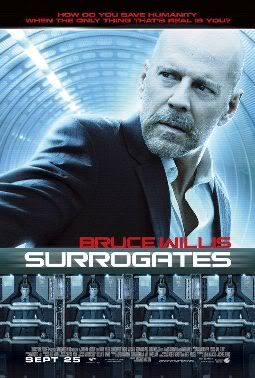
Review: Surrogates


There's a certain kind of excitement that washes over me whenever I read about a sci-fi movie which deals in a particularly heady subject.  For me, good, well thought out sci-fi is one of the best things in the world.  The worlds they present, the questions they pose, the conversations they spark; well-made science fiction can get my friends and I to argue and discuss and think about life's smallest issues as well as its grandest controversies.  At the same time, there's a certain kind of disappointment when a film with such promise squanders all of its potential.  Jonathan Mostow's Surrogates is just such a film.

The film presents a near-future in which 99 percent of the world's population (think on THAT one for a few minutes) operate robotic avatars from the safety of their own homes.  The robots look like flawless humans; physically superior versions of our fragile, ugly selves.  When the son of the surrogates' inventor is murdered through his surrogate, detective Tom Greer (Bruce Willis) is called on to find the killer.  Have I killed your interest yet?  Because this is precisely where I started tuning out.  Such a fantastic concept is given a backseat to a standard, run-of-the-mill murder mystery.

This wouldn't be such a big problem if the murder mystery weren't so completely labyrinthine.  In any other movie, it would be fairly straightforward.  With the presence of surrogates that anyone can swap out at any time, it becomes increasingly difficult to keep track which person is controlling which robot.  And then when you throw in red herrings and other typical murder mystery cliches, it all makes Surrogates more complicated than it needs to be, and less interesting than it ought to be.  Add to this the fact that the because movie isn't even 90 minutes long, there's little time for the movie to settle into any kind of rhythm, let alone explain itself clearly.

For what it's worth, the practical and CG effects for the actual surrogates is pretty top-notch.  In his robot form, Bruce Willis looks younger than he has in decades, which admittedly was the point, but it's offset by a hairpiece that's pretty laughable.  Other actors and their robo-selves come off better though (Rosamund Pike in particular), and on a purely basic level, the concept works.

Surrogates probably would've played better during the summer months where audiences might have been more willing to shut their brains off and enjoy the ride.    As it stands, the movie washes over you and seems to dare you to try and analyze it.  Instead, it squanders its massive potential in favor of exploring territory that was already effectively mined in I, Robot.  It's not really a bad film, but it could have been so much more.  In some ways, I think that makes Surrogates even worse.

2 ( sadsad ) stars out of five.

Wednesday, September 9, 2009

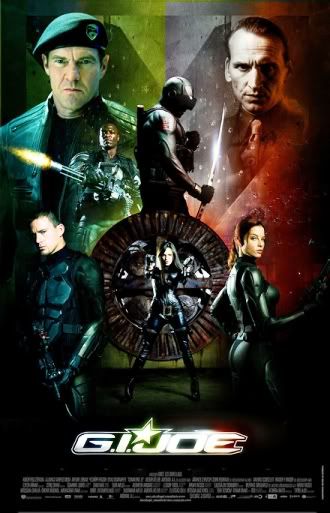
Review: G.I. JOE - The Rise of Cobra


Simply for reference, I'm going to link you to my review of Transformers: Revenge of the Fallen, because these are essentially the same movie.

Almost every complaint that I leveled at Transformers 2 can reasonably be applied to G.I. JOE - The Rise of Cobra.  It's loud, it's flashy, it's grade-A stupidity, and there are too many plot threads going on at once.  However, these two films differ on two key elements: Stephen Sommers' G.I. JOE at least attempts to make something resembling sense, and it never forgets to include that most crucial of summer blockbuster elements.  Fun.

The Rise of Cobra is a simple enough story.  US soldiers Duke (Channing Tatum) and Ripcord (Marlon Wayans) are attached to a unit transporting a case of biomechanical warheads.  The unit is attacked by super-armed terrorists Anna (Sienna Miller) and Storm Shadow (Byung-hun Lee), who are then thwarted by G.I JOE, an international super squad.  Duke and Ripcord tag along back to the G.I. JOE base, where they're integrated into the team.  From there, it becomes a long episode of the cartoon, complete with the Cobra terrorists stealing the warheads, attacking Paris, and G.I. JOE striking back.

In between the obligatory plot points, we're shown a lot of cool gadgets, no end of villainous posturing (by Christopher Eccleston and Joseph Gordon-Levitt, of all people), and several good gags along the way.  It should be noted that G.I. JOE is by no means a good film.  There's no question that it's exactly the same kind of lowest-common-denominator filmmaking that made Transformers 2 such a ridiculously huge hit a month ago.  As the lead actor, Channing Tatum sucks all the energy out of any scene he's in which, as it turns out, is most of them.  To balance him out, though, is a mostly well-chosen cast of Joes and Cobras to keep the film moving.  In fact, the amazing thing about the movie is how Tatum is the only one underplaying his role, when all around him are actors hamming it up.  It's almost as though Stephen Sommers forgot to tell him he was starring in a live-action cartoon.

Walking in, I had a pretty solid idea of what I was in for.  I knew I was sort of in for a repeat of Transformers 2.  For the first five minutes or so, that's what I got.  There was even a certain point early on where I completely zoned out and started thinking about something else entirely.  Thankfully, once the action started, I was surprised at how easy most of it was to follow.  While still chaotic and generally silly, there was never any confusion about what was going on.  Then I got to know the characters, and I was pleased to see that the film isn't nearly as far removed from the 1980s cartoon as I was expecting. 

Of course, for every interesting turn, there are a couple that are completely unnecessary.  The car chase through Paris is fun, but drags on for far too long.  Just about every major character has a character-building flashback (Storm Shadow has at least three), which give us details that were alluded to more fluently in previous scenes.  These scenes seem engineered to keep the less astute viewers up to speed, but to the keen eye they just feel tedious.

I suppose that I enjoyed G.I. JOE at all stems from the fact that my expectation was very, very low.  Of course, my expectation for Transformers 2 was equally low, if not lower, and I ended up hating that film.  So where's the disconnect?  Perhaps it's the fact that this film isn't nearly as in-your-face obnoxious.  Perhaps it's because there are no mind-bogglingly stupid gaps in logic (not that it's air-tight or anything). 

For whatever reason, I actually had a good time with G.I. JOE - The Rise of Cobra.  Granted, this isn't the kind of film I'll be revisiting any time soon, but for what it is, it's exactly the kind of fun that this summer has been sorely missing.  If you don't expect too much out of the film, it's surprisingly fun.  I realize that's faint praise, but that's exactly the kind of film this is.  Light, fun, and not too awful.

I'm giving this one 3  stars ( unsureunsureunsure ) out of five.

Thursday, August 27, 2009

Blu-Ray Review: Hot Fuzz


Officially, Edgar Wright's brilliant Shaun of the Dead and Hot Fuzz aren't slated to hit Blu-Ray shelves in the US until late September.  Best Buy, however, has released the two a full month early.  Days ago, I scoured the internet looking for any kind of review, but all I could find were useless user reviews on Amazon.com.  Thanks, guys, I know all about the movie itself.  What about the features?  The digital transfer?  THAT is what I'm here to give you today.

If you're not familiar with Hot Fuzz, you're missing out on one of the best comedies of the decade, and one of the most well-executed parodies ever made.  It's your basic fish-out-of-water plot.  Nicolas Angel (Simon Pegg) is a London supercop who's so good at his job that the higher-ups transfer him to a small village to keep him from putting everyone out of a job.  From the moment he arrives in Sanford, Angel begins investigating a series of murders with his new partner (Nick Frost), and the two end up arresting or killing half the town.

The plot itself is deceptively simple, but the devil is in the details.  The movie flirts with half a dozen film genres, and pulls off each one with ease.  It's a buddy comedy, it's a slasher flick, it's a murder mystery, it's an over-the-top action movie, etc.  Of course, if the movie is parodying anything in particuler, it's the Tony Scott/Michael Bay-style action flick.  Edgar Wright admittedly loves movies like Bad Boys II, and that love is apparent in every scene.  Just like with Shaun of the Dead, it's to Wright's credit that Hot Fuzz is just as good a cop movie as it is a comedy. 

This is a film that works infinitely better on DVD than it did in theaters.  On the big screen, you're simply overwhelmed by the ridiculous spectacle of it all.  At home, you can take full advantage of the pause and rewind functions to catch jokes you might have missed or watch your favorites again.  What I love about Hot Fuzz is that with each viewing, I either catch a visual gag I missed the last time, or a whole series of one-liners and references that hadn't occurred to me until now.

So how's the blu-ray?  In a word, great.  The film already has that desaturated, high contrast cop-movie feel to it, and the 1080p transfer really looks crisp, bringing out the occasional flourish of color quite nicely.  I can't say it's a reference quality transfer, as the difference between this and the standard DVD isn't too noticeable.  But considering Hot Fuzz didn't have much of a budget (about $13 million) anyway, this is as good as it's ever going to look.

Then there are the features.  Every single special feature from the 3-disc standard DVD is present here.  No less than five audio commentaries, production diaries, trailers, deleted scenes, outtakes, storyboards, interviews, it's all here.  Even Edgar Wright's hilarious student film Dead Right is included, with it's own commentary no less.  Also, as is the custom with blu-ray discs, there are some interesting "U-Control" features as well.  At $20, If you've somehow held out this long on Hot Fuzz, you'll definitely be getting your money's worth and then some with this blu-ray.  I can only assume the Shaun of the Dead blu-ray received equal treatment, and I sincerely hope it did, because this disc is exceptionally put together.

THE MOVIE: 8/10  -  Hot Fuzz is equally hilarious and thrilling, and proves Edgar Wright to be the Quentin Tarantino of comedies.  Wright knows his action movies inside and out, and directs Hot Fuzz like he's been doing it for decades.  Truly great parodies are few and far between.  This is Wright's second great parody in a row.

THE BLU-RAY: 9/10  -  Not quite reference grade, but definitely a step up from the standard DVD.

THE FEATURES: 10/10  -  Three discs worth of special features are all crammed onto this one disc.  Some might argue that the number of features detracts from the quality of the film transfer, but if that's the case I definitely can't tell. 

OVERALL:  9/10  -  This is easily one of the best values for your blu-ray dollar.  And if you're upgrading from your standard DVD, this'll give you a little extra room on your shelf.  A hilarious, well-produced movie and a well-spring of features, all for a decent price.  How can you beat that?

Monday, August 24, 2009

Review: District 9


 There are two types of science fiction.  Soft sci-fi and hard sci-fi.  Soft sci-fi is the kind of science fiction that's more about the action and spectacle of seeing things go boom, or take a sci-fi concept to tell an otherwise contemporary story.  It may take place in a futuristic or science-fictional setting, but there's little real science in it.  Think Transformers or The Time Traveler's Wife.  By contrast, hard sci-fi deals more closely with scientific concepts in telling its story.  Gattaca, Blade Runner, 2001, all of these would be considered hard sci-fi.  Very rarely will you find a movie or book that can blend the hard and soft without diluting the whole thing.  District 9 is the rare film that manages to do just that. 

28 years ago, an alien spacecraft entered Earth's atmosphere and came to rest hovering over Johannesburg, South Africa.  Deciding to be the first ones to make contact, human military units cut their way into the ship and discovered a plethora of worker aliens on the brink of death.  The aliens are removed from the ship and placed into temporary housing in a new district of Johannesburg.  District 9.  Present day, MNU (think United Way meets FEMA) employee Wikus van de Merwe (Sharlto Copley) is tasked with evicting all the aliens and relocating them to new, supposedly more efficient housing (District 10).

Needless to say, things don't go smoothly for Wikus.  Almost immediatly, he's infected with a mysterious alien fluid, and his body is confiscated by MNU for testing.  What began as a sort of faux-documentary soon becomes something more streamlined, as we follow Wikus' struggle to escape MNU, survive as a fugitive, and unravel the secret of District 9.  I'm only giving you the basics, and saying any more would ruin one of a hundred surprises that District 9 has up its sleeve. 

District 9 had something of a checkered production.  Early on, director Neil Blomkamp and producer Peter Jackson were in the planning phases of a Halo movie.  When the studios refused to give them the budget they wanted, Jackson gave Blomkamp considerably less money ($30 million) and carte blanche to make whatever he wanted.  The result, District 9, is adapted from Blomkamp's original short film "Alive in Joburg".  You can see the Halo influences in the film.  A lot of the vehicles and weapons used in the film were clearly meant to be Spartan assault rifles and Warthogs.  Not that that's important to enjoying the film, but it's something interesting to notice.

Now, earlier I said that District 9 blends the hard sci-fi and the soft sci-fi remarkably well.  Yes, there are high-minded concepts like bioengineering, apartheid, war crimes, weapon smuggling, etc.  There are some really tough issues to deal with in District 9, but they're not overbearing.  If you don't feel like contemplating alien apartheid, there are plenty of well-executed action sequences to keep you occupied.  And not only are they well-executed, but the effects work is remarkably convincing for such a small budget.  The aliens (derisively referred to as 'prawns') occasionally look too plasticy, but they never stick out like sore, alien thumbs. 

But perhaps the single greatest thing about District 9 is its central character, Wikus.  Wikus' journey is not an easy one to watch, but Blomkamp knows exactly when to make us fear for him, when to cry for him and when to cheer for him.  And trust me, you WILL be cheering for Wikus before the end.  But perhaps even more surprising than the human story is the alien story.  Wikus meets up with an alien engineer named Christopher Johnson.  Christopher and his Earth-born son have a plan for getting the mothership back online, and they form a tentative partnership with Wikus.  While Wikus' story is predictably grim, Christopher's story goes to some fairly dark places of its own.

Overall, District 9 is a complete tour-de-force of sci-fi storytelling.  It's completely engaging, fascinating, terrifying, and even a little heartbreaking.  I'm not even sure what I can compare this movie to, and I think that's going to be my ultimate praise.  This is a wholly original work that any fan of science fiction owes it to themselves to see at least once.

5 ( lollollollollol ) stars out of five.  Seriously.

Thursday, August 20, 2009

In Defense of the Avatar Trailer

If today's internet buzz was any indication, Avatar Day (tomorrow) is going to be insane.

Let me back up for a moment.  Today, Fox released the first official trailer for James Cameron's latest sci-fi epic, Avatar.  You can watch the trailer in all its 1080p glory over at Apple.com.  Go on, I'll wait.

Done?  Ok, let's continue.

Already, the internet is all atwitter over what to think of this behemoth.  Seriously, Twitter just exploded this morning.  The reason for my posting here today is because all the buzz over this thing is decidedly not good.  People are complaining that the CG looks plasticy and fake.  There's no sense of story; there's only one line of dialogue; it looks like 10,000 BC meets Aliens.  From the established movie bloggers, the primary complaint seems to be that the sense of scope is completely missing from the 25 minutes of footage that all the Twilight fans got to see at the San Diego Comic Con.

So let me say this as clearly as I can.  THIS IS A TEASER.  For all intents and purposes, it doesn't make too much sense for James Cameron, Fox, et al to reveal everything as early as August.  What is it about the concept of a teaser that people just don't understand?  A full trailer will probably hit some time in October, and that's going to be the one to scrutinize. 

The other issue is the CG element.  Complaints that Cameron's 10+ years of research and development were all for naught seem a bit overzealous, don't you think?  From those who were actually at Comic Con, the CG does indeed look gorgeous.  This is a film clearly meant to be experienced on the big screen, so why nitpick it on a 14 inch computer monitor?

Sure, the average joe moviegoer probably isn't going to be able to make heads or tails of this trailer beyond "Some guy puts his brain into an alien and flies around and does stuff.  And he's blue."  Going online and actually looking up the plot synopsis or (God forbid) waiting for the full trailer will reveal much more about the nature of the film, and I honestly hope the moviegoing public will show that kind of enthusiasm for this film.  Say what you want about the teaser, but it shows far too much promise for the general public to poo-poo it right away.

I guess my plea, if there must be one, is for you the viewer to keep an open mind about Avatar.  There is a very good chance that James Cameron WILL blow your mind, but you need to be willing to take that journey.  Chances are, if you haven't seen the teaser by now, you'll be seeing it in front of Inglourious Basterds this weekend.  An initial hatred of this teaser is only the first step in your ultimate disappointment.  A better trailer will come, trust me.  For my part, the clarity of the CG is secondary if the story is one worth telling.  I can't wait to see what else Avatar has up its sleeve.

Monday, July 20, 2009

Review: Moon


A lot of different stories fall under the category of science fiction.  Space opera, time travel, cyberpunk, etc.  And though the 2000's have given us a number of great films in each of those categories, few if any have reached the heights of Star Wars, Back to the Future, or Blade Runner.  Enter Duncan Jones' film Moon.  I'm not saying it's as great as any of those films, but what it is is one of the purest science fiction films of the decade.  It's not as grandiose as the Star Wars prequels or as ambitious as, say, Danny Boyle's Sunshine, but in it's own way manages to fascinate and entertain in equal measures.  It gets so many of the minor details right that it really sucks you into the story.

Moon's story is a simple one.  Astronaut Sam Bell (Sam Rockwell) works on the Sarang mining base on the far side of the moon, where he's been working alone for the past three years.  His only companion is the base's robotic system, named GERTY (voiced by Kevin Spacey), and after three years Sam is starting to suffer the emotional stress of isolation.  During the final two weeks of his contracted stay, Sam discovers the base's dark secret (it's always a dark secret, isn't it?), and begins frantically searching for a way home.

I don't want to say anymore, because even though the film's twist comes 30 minutes in, the story is every bit as fascinating for where it doesn't go as where it does.  Certain parts of Moon are, indeed, predictable, but the film is deceptive in that it telegraphs just enough so the viewer thinks they have it figured out.  At other times, the film suggests certain forboding possibilities and then leaves it up to the viewer whether or not such things are the case.  The film offers several possibilities as to how Sam might end up dead, and then shows remarkable restraint in not overplaying its hand.

So yes, this is indeed a wonderful little piece of science fiction, but the real reason to seek out Moon is for Sam Rockwell's excellent performance.  He's more or less a one-man show here, and he's able to run the gamut of emotions, from emotional distress to violent rage to giddy aloofness, all in a matter of minutes.  Rockwell never oversells it or underplays it, but manages to hit that emotional sweet spot and make the viewer feel for this poor guy.

All the best science fiction films are about more than what's presented on the surface.  In just over 90 minutes, Moon manages to tackle space exploration, alternative energy, artificial intelligence, genetic engineering, space madness and, yes, dark corporate secrets.  That it meshes all of these into one brief, cohesive film is an impressive feat unto itself.  The finale is a bit on the underwhelming side, but there's still enough here to satisfy any sci-fi fan.  If you need a good, hard science fiction film to take the edge off junk like Transformers 2 or Star Trek, you owe it to yourself to check out Moon.

4.5 stars ( big grinbig grinbig grinbig grin1/2 ) out of 5.

Sunday, July 12, 2009

Review: Bruno


Bruno is a difficult film to review.  On the one hand, it is extremely funny.  This is the hardest I've laughed at a film all year long.  If anything else, Bruno at least has that going for it.  But on the other hand, the novelty of Sacha Baron Cohen's shtick has clearly worn off.  Gone is the charming aloofness of Borat, a character who simply didn't know better, and in its place is a character whose shocking abrasiveness exists out of some bizarre desire to become famous at all costs.

The film opens with Austrian fashion reporter Bruno (Sacha Baron Cohen) committing career suicide by appearing at an Italian fashion show wearing a velcro suit.  Following the incident, he decides that the only course of action is to go to Hollywood and "become famous".  The bulk of the film is little more than a series of ridiculous sketches wherein Bruno tries out various methods of achieving fame.  Starring in a TV pilot, organizing a charity, attempting to end the conflict between Jews and Muslims, etc.

Sure, there's a loose framework of a story what with Bruno narrating the transitions between segments, but look past that and you'll see the film for what it really is: an 82 minute exercise in baiting homophobes, idiots, and assholes.  And yeah, that can be funny (and often is), but there's nothing to it.  There's no reason for Bruno's flamboyant rampage across the country. 

I think part of the problem is that, after Borat, we're all looking for the gimmick, the shtick, the gag.  Borat worked because most people had never heard of the character or the comedian underneath.  Now, Cohen's got to go pretty far out of his way to get a rise out of his audience.  It's still pretty easy to prank on unsuspecting people, but it feels like Cohen's trying too hard to entertain or shock his audience.  Here, the line is thankfully drawn at gay sex onscreen, but I have a feeling Cohen would go there if he thought it would get a reaction.

I guess my complaint boils down to the fact that Bruno is largely without subtext.  The movie is hilarious, and parts are certainly eye-opening (the finale, with Bruno playing the role of Straight Dave at a UFC event), but it all means nothing.  Borat worked because there was at least a through-line to the character's roadtrip across the US.  Bruno's quest to become famous simply reveals the film to be nothing more than the PR stunt that it wants us to think it's mocking.

If this kind of comedy is your thing, if you enjoyed Borat at all, you'll probably find Bruno pretty hilarious.  I definitely did.  Just don't try to read too much into it, because you almost certainly will find it lacking.

3 stars ( drydrydry ) out of five

Thursday, July 9, 2009

Review: Away We Go


Depending on what stage you're at in your relationship with your significant other, Away We Go would either make a perfect or a terrible date movie.  Having seen the film by myself, I personally couldn't say, but I'm willing to bet that you wouldn't want to see this on a first or second date.  Away We Go is the kind of film that likely will appeal more to newlyweds and parents than to teenagers on a first date.

Not to suggest that its demographic is set in stone or anything; that's based solely on the characters and their situation. The movie begins with Burt (John Krasinski) discovering that his longtime girlfriend Verona (Maya Rudolph) is pregnant.  Cut to months later, when the two visit Burt's parents (Catherine O'Hara, Jeff Daniels) to deliver the sonogram photos.  Here, Burt's parents announce that they're moving to Belgium right before the baby is due.  Burt and Verona take the news as an opportunity to pull up stakes and find a better home for themselves and the fast-approaching baby.

From there, the film hits its groove as a road trip movie, with our couple bouncing from Phoenix to Tuscon to Madison to Montreal to Miami in search of the perfect place to raise their daughter, only to find that all of their family and friends are tragically bad role models for both them and the baby.  Verona's former boss (Allison Janney) is a lush who sees no problem with disparaging her two pudgy kids in public.  Burt's childhood friend Ellen (Maggie Gyllenhaal) is a hippie/feminist/whatever with some... odd views on sexuality.  Their college roommates (Chris Messina, Melanie Lynskey) have adopted four kids while repeatedly failing to produce their own.

It seems like everywhere you look in this film, there's a horrible (or at the very least tragic) individual threatening to kill any hope for Burt, Verona, and even the viewer.  But to what end?  To show that everyone in the world is a terrible person?  That it doesn't matter where you live, problems exist everywhere? That's getting close to it, I think.

It still puzzles me why the film is little more than an episodic journey in bad parenting, but the counterpoint to that is the fact that John Krasinski and Maya Rudolph are pretty great in this film.  They're our proxies.  They think all these people are just as messed up as we do.  Krasinski plays Burt as a big kid who's whole-heartedly dedicated to bringing his own kid into the world the right way, and a lot of the film's charm rests solely on his shoulders.  In contrast, Maya Rudolph is calmer and more subdued than her work on Satuday Night Live suggested she could pull off.  If Krasinski is the comedic center of the film, Rudolph is the emotional center.

Overall, Away We Go isn't anything to rave about, but it's a far sight better than most of the big, dumb action movies released this summer.  If maybe not a truly memorable film, it is at least the perfect counterprogramming to the summer movie season.  I'd recommend it to anyone looking to escape from the exploding excess of films like Transformers, or those seeking a fresh take on the whole rom-com genre.

smilesmilesmilesmile 4 stars out of five

Thursday, June 25, 2009

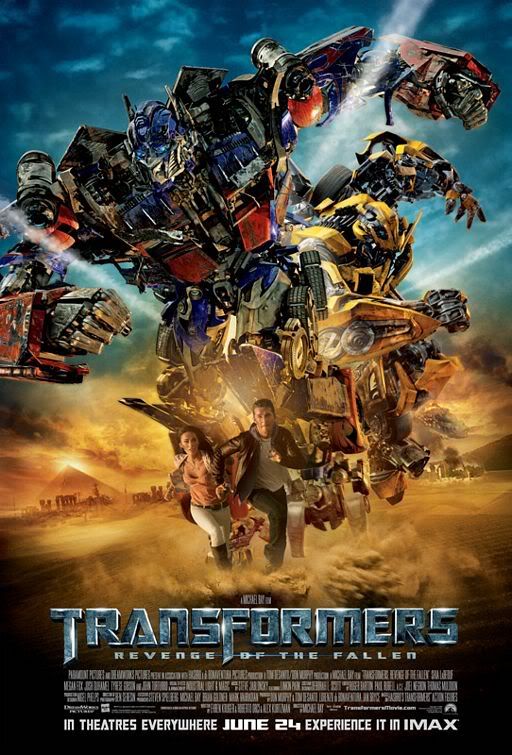
Review: Transformers: Revenge of the Fallen


 I am a male human.  I am twenty-two years old.  I am a sci-fi geek.  As a kid, I watched my share of Transformers cartoons.  I am, for all intents and purposes, the primary target audience for Michael Bay's Transformers movies.  And yet, I'm not sure whether I'm supposed to take Revenge of the Fallen seriously or if it's the biggest, most expensive and mind-numbing practical joke of the year.

One thing is certain: this film is definitely not a misfire.  Michael Bay and his three writers knew exactly what they were doing when they put this film together.  Revenge of the Fallen is a film that takes everything ridiculous, overblown and aggravating about the previous film and amplifies it tenfold.  For lack of a better comparison, it's Michael Bay's version of Crank 2.  Despite being a blatant ripoff of Independence Day, 2007's Transformers was at the very least coherent.  The sequel is far too scatterbrained and schizophrenic to even concentrate on one plot thread, let alone a dozen.

The film opens in Shanghai, with the Autobots working with a military team called NEST to hunt down rogue Decepticons.  Despite being a little hard to follow, this is a great concept for the film to start on, but the whole thing just goes downhill from there.  Meanwhile, after killing Megatron with the All Spark at the end of the first movie, Sam Witwicky (Still Shia LaBeouf, still annoying) is off to college, but not before discovering a sliver of the All Spark in his sweater, which imprints Cybertronian hieroglyphics onto his brain.  A Decepticon named The Fallen then arrives on Earth in search of the Matrix of Leadership, which he plans to use to destroy the sun (I guess).  The only one who knows it's location?  Yup.  Sam. 

That is literally the shortest plot description I can give you without simply saying "The Decepticons want something and the Autobots have to stop them from getting it."  Actually, that's all this movie is.  It's a fetch quest.  How Michael Bay managed to turn such a simple premise into 150 minutes is beyond me.  Of course, the plot doesn't really matter.  We're paying to see giant robots fighting, and by God that's exactly what Bay gives us.  What seems like the entire last hour of the film is dedicated to a battle in and around the Pyramids of Giza, and while it's definitely intricate and an amazing feat of special effects work, it makes practically zero narrative sense.

Entire plot threads are introduced only to be abandoned or twisted inside out thirty minutes later.  Characters die early in the film, only to be brought back at the zero hour.  Other characters seem motivated entirely by whims or hair-brained notions of their importance to the plot, others serve seemingly no purpose other than to maintain continuity, and still others show up for brief cameos, when I'm fairly certain they were killed off in the last film.

Thinking about Revenge of the Fallen for too long will almost certainly give you a headache, if the screening didn't do that for you already.  Failing that, the comic relief will drive you insane.  Not because it's hilarious, but rather because it's not and there's far, far too much of it.  In particular, two Autobots named Mudflap and Skids.  Of all the CG robots in this movie, they're the only two that actually resemble cartoon characters, and they're 100% walking, talking racial epithets of the worst kind.  Between those two and Sam's mother, this film features three of the absolute worst characters to show up in a film this year, possibly this decade.

Dogs humping dogs, robots humping people, robots speaking jive, robots walking with canes, people visiting robot heaven, John Turturro's ass.  Oh, and robot testicles.  Indeed, Transformers: Revenge of the Fallen truly has it all.  Every visual excess that you could possibly want in a summer blockbuster is right here, lovingly captured on film for all eternity.  If I have anything positive to say about the movie, it's that Michael Bay does, indeed, know how to make a film look good.  For every horribly stupid gag or plot point that Bay throws at us, we at least get to see what we paid for.  Giant robots kicking the crap out of each other.  But, ya know, sometimes that's just not enough.

The only reason I would possibly recommend seeing this would be to see how gloriously stupid the film truly is.

madmad  2 little angry faces out of 5.

Wednesday, June 3, 2009

Review: Up


The question of whether or not the new film from Pixar Animation Studios is any good is a moot one.  Of course it's good.  So far, Pixar's track record is ten for ten.  The debate rages on about Cars and A Bug's Life, but nobody will argue that they aren't at least well-crafted, if certainly not instant classics.  At this point, the question with Pete Docter's Up is instead how good is it?

Up shares a lot in common with Monsters, Inc., Docter's previous film, both in general quality and the way in which it tugs at the heartstrings.  Like Ratatouille and WALL-E before it, Up deals in a more sophisticated range of emotions that will almost certainly hit adults like a sledgehammer.  At the same time, the film balances its emotional weight with some truly weird humor and all sorts of sight gags that'll keep the kids laughing.

The film opens with perhaps one of the best montages ever put to film.  We follow an adventurous young boy named Carl as he meets his new best friend, an equally adventurous girl named Ellie.  From there, we watch the two plan for an adventure, only to give in to the slow march of time and the realities of life. After Ellie dies, urban construction threatens to take Carl's house, so rather than be put in a nursing home, Carl vows to take the trip he and Ellie always dreamed about: to Paradise Falls in South America.  From there, you've seen the trailers.  Carl and a stowaway boy scout named Russell fly off to South America in Carl's house, fitted with hundreds of balloons.

From there, not only does the plot get kinda strange, it also starts to fall apart a bit.  The journey that Carl and Russell take is never in question.  They go to South America, make an unexpected friend, meet an unexpected villian, and hijinks ensue.  Up's greatest strength lies in its ability to mine unexpected depth from characters in such wacky circumstances.  Without going into too many spoilers, Carl becomes a sort of father-figure to two characters, Russell and a talking dog named Dug.  That dichotomy of mentor/protege is what drives the second half of the story (not to mention the presence of talking dogs).

However, interesting though all that might be, the plot itself can't evenly support such weirdness.  I guess you could call the narrative a series of curveballs, because the plot does go exactly where you think it'll go, but the surprise is in how much time the film spends on any one part of the story.  Personally, I thought Carl's journey to Paradise Falls would be the driving force of the movie.  Instead, he and Russell make it there fairly quickly.  There was never any question that it would happen, but the way the film gets from point A to point B is a bit maddening.  I'm glad that my expectations were warped somewhat; I guess what I'm saying is that there has to have been a better way of pulling that off.

All narrative clunkiness aside, Up is a fantastic piece of animation.  If you don't leave the theater quoting Dug or the other dogs, you'll be marveling at the artistry behind Carl Fredrickson's facial stubble, or at the very least talking about how cute the short before the film, "Partly Cloudy", was.  It's wonderful to finally have a film this summer to rave about, however mildly.  Compared to some of the in-your-face explosionfests so far this summer, Up is a welcome hour and a half of fresh air.  (Heh.)

4 stars ( smilesmilesmilesmile ) out of five.

Friday, May 15, 2009

Angels and Demons


Three years ago, Ron Howard's film adaptation of Dan Brown's "The Da Vinci Code" was met with a lot of controversy, but decidedly negative reviews. That film was a plodding snoozefest when compared to likeminded series like Indiana Jones, National Treasure, or even The Librarian. Thankfully Howard's follow-up, Angels & Demons, fares a bit better than its predecessor on pretty much every level.

After the events of The Da Vinci Code (the book occurs before Da Vinci, but the film is written as a sequel), professor Robert Langdon (Tom Hanks) is recruited by the Vatican to investigate a bomb threat from a secret society known as the Illuminati, who've also kidnapped four Vatican cardinals. Accompanying him is physicist Vittoria Vetra (Ayelet Zurer), recruited to recover a canister of antimatter stolen from the Large Hadron Collider. Together, and with the help of the Vatican police force, the two race across Rome to rescue the four cardinals and prevent the antimatter from being used to destroy Rome. Yes, you read that last part correctly.

The plot is twisted and convoluted in certain places, and it seems like writers Akiva Goldsman and David Koepp (not exactly a screenwriting pedigree) are desperate to up the tension and add suspense at every possible turn. Ticking clocks ("one cardinal will die every hour") are fine. It's what many action movies and thrillers are built around. But when you introduce the idea of rolling blackouts early on, there's no drama when our heroes' lives are endangered by it an hour later.

The scene I'm referring to turns out to be a red herring, and that's one of the film's key problems. There are far, far too many red herrings. If you haven't already figured out who's behind everything already, the red herrings force you to give up the chase and just turn your brain off. I'm willing to bet they're counting you to shut your brain off, because the film features a bizarre fourth act completely undoes all of the heroic drama that the climax could muster. The film seemed like it would actually go out on a high note, only to renege on it completely. It really doesn't work, and I'm not sure if the problem is with Koepp/Goldsman or Dan Brown.

But, for what it is, Angels & Demons does have its moments. The action may be on the mundane side, but the investigative side of the film is actually quite interesting. Whereas The Da Vinci Code felt like one long history lesson after another, Angels & Demons manages to balance the information without feeling like too much exposition. The film itself looks gorgeous, featuring great cinematography of some of Rome's most historic landmarks. Tom Hanks does well, but there's nothing groundbreaking about his performance. The real highlight of the film is Ewan McGregor, whose Carmelengo McKenna is perhaps the most interesting character in the film. He's young, seems poised for greatness, yet is all too conservative about his duty. Compared to the other clergy in the film, his is a character we want to learn more about, but are never afforded the chance.

If you're like me, and you enjoyed the premise of The Da Vinci Code more than the delivery of the film itself, you should enjoy Angels & Demons somewhat. It's not a great film by any means, but it is a fun diversion for an afternoon. It's decidedly average, but at least falls on the positive side of average.

3 stars (***) out of five.

Thursday, May 14, 2009

Connor vs. Connor

Crossovers and spinoffs have been a part of storytelling ever since Odysseus and Aeneas left Troy going in opposite directions. Perhaps the most popular form of crossover fiction is the sci-fi mainstay "Franchise A vs. Franchise B". Alien vs. Predator. Robocop vs. Terminator. Batman vs. Superman. Star Trek meets the X-Men. Freddy vs. Jason. Army of Darkness vs. Marvel Zombies. Turtle vs. Bunny. I could go on all day. Few such crossovers ever really work, and most of them are just plain silly. But there's one crossover I'd like to propose for serious consideration.


Highlander vs. Terminator.

Now, sadly, I wasn't the first to think of this, but let's think about this for a second. What better fit for a franchise that constantly meddles with time travel than characters that transcend time? It's better than ninjas vs. pirates. It's immortals vs. robots, two character types that are fairly similar, if only on a base level. The only way to really kill either is to cut off the power source (head). Of course, the danger with Terminators is the fact that they're freaking legion, whereas the number of Highlander immortals, by their very nature, are dwindling. So that's a negative.

However, the great thing about the Highlander universe is that the only thing that really matters are the characters. You could drop Connor McLeod (or Duncan or whoever, doesn't really matter) into the Terminator universe without much difficulty. Unless he has the misfortune of being in a major city on Judgement Day, chances are he'll survive the fallout. But then comes the previously mentioned army of T-800s and Lord knows what else.

Here's where things get a little tricky. Unless a Terminator directly witnesses one immortal behead another, it's not going to know enough to do the same to the Highlander. It'll fire away at him, probably hit him a couple times, but it wouldn't kill him. Of course, a T-1000 wouldn't have much problem with that. Remember what happened to Todd in T2. No heads were removed, but the potential is definitely there. Ooh, there's a challenge for the Highlander... Of course, it's doubtful that Connor's sword would be enough to destroy even a T-800.

In my proposed Terminator/Highlander film, there would undoubtedly be more than one immortal. Otherwise, what's the point? Early in the film, Connor squares off against another immortal, only to have their duel interrupted by a Terminator. The two team up to incapacitate the robot, after which Connor catches his erstwhile partner off guard, beheads him and a Quickening ensues. Connor then gains all the knowledge of the other immortal, including key information on SkyNet. Weaknesses, plans, etc. Maybe this other immortal once worked for CyberDyne Systems. Then, Connor finds his way to the Resistance, where he helps John Connor concoct a plan to finally take out SkyNet.

Maybe John Connor doesn't believe McLeod. How could someone know so much about SkyNet unless they were actually a robot? So Connor tries shooting McLeod a few times. McLeod doesn't die. John Connor still isn't convinced. As far as he knows, McLeod is 100% machine. So they come up with a test. They place McLeod in front of a giant magnet. When switched on, the magnet does nothing. Maybe it picks up his sword. But not him. That's enough for John Connor, who agrees to let McLeod help, but still falsely suspects him of being some kind of trap set by SkyNet.

I realize what I just did was tantamount to fan fiction but, really, that's no worse than some of the other dumb crossovers we've seen. I even think this is a better idea than some of those. I think a Highlander would fit right into the upcoming Terminator movie. And really, with the Highlander franchise as labyrinthine and convoluted as it is, would anybody really care?

What do you think?

Sunday, May 10, 2009

Star Trek

I was primed to love every minute of Star Trek. The trailer had me psyched to see it. Early word was that the film was one of the best Trek movies ever, perhaps even THE best. I bought my Burger King promo glasses, I rewatched a couple of the previous Trek movies and hoped that, at worst, J.J. Abrams would deliver a film that was at least better than Mission: Impossible III. Well, he at least succeeded that far, but only by so much. Abrams' prequel/reboot/whatever is an entertaining ride, no question, but it falters in trying too hard to appeal to as broad an audience as possible.

Possible spoilers. Fair warning.

The film opens with the USS Kelvin being attacked by a gargantuan Romulan mining vessel, captained by Nero (Eric Bana). The acting captain of the Kelvin just happens to be father to James T. Kirk, and the day just happens to be the day James is born. Baby James, his mother, and the rest of the crew escape while 'Captain' Kirk attacks Nero's ship head-on. Fast forward 25 years, where we meet back up with Jim (Chris Pine), who is dared to join Starfleet by Captain Pike (Bruce Greenwood), who served under Kirk's father on the Kelvin. From there, we watch Kirk go through Starfleet Academy, verbally spar with a young commander named Spock (Zackary Quinto), find his way onto the brand spanking new Enterprise with an equally young crew, and then come face to face with Nero himself.

As a movie, it is certainly a step in the right direction from the decidedly less enteresting Insurrection and Nemesis. The production benefits from a mostly well-chosen cast and top notch effects work. Of this younger crew, Chris Pine and Karl Urban (Kirk and Bones, respectively) come off the best. Pine gets the reckless swagger of Jim Kirk down to a science, while Urban is a dead ringer for DeForest Kelley, both in appearance and performance. Additionally, Eric Bana's Nero is a character that is quite compelling for his limited role. Perhaps not on the level of Khan or the Borg Queen, but a character absolutely deserving of more screen-time. As this is an origin story (kind of), the movie relegates Nero to the background while we get acquainted with this new, younger Enterprise crew. His scheme, as genocidal and devastating though it may be, is ultimately shrugged off as a means of getting things in place for subsequent films.

Perhaps the most disappointing portrayal is Quinto as Spock. He's not bad, necessarily, but his take on Spock's emotionless visage is a constant wide-eyed stare and slightly pursed lips. It simply proves that his casting was purely aesthetic. He looks the part but can't quite act it. The problem is amplified by the fact that Leonard Nimoy himself shows up for about 20 minutes as the future version of Spock (or rather "Spock Prime"). The difference is staggering. In fact, Nimoy's role proves to be (ironically) the emotional high point of the film. There's a warmth in his portrayal of Spock that is absent from the majority of the film.

And I think that's the primary problem with this new Star Trek. The newness of everything is glaringly apparent in almost every aspect of the film. From the frantically paced plot to the equally fast editing and whiplash-inducing camerawork, to Abrams' over-indulgence on lens flares, everything about this movie smacks of the "dumb summer action movie" that Abrams clearly intended on making. That, in itself, isn't necessarily a bad thing, but when it comes at the expense of the science and (yes) logic that the series always championed, it sort of defeats the whole purpose of Star Trek.

I could go on about how the new Enterprise looks like a flying iPod or how the crew's standard operating procedure seems to only consist of "Move over, let me do that," but it's pointless. The movie is, in fact, a dumb summer action movie, and on that front it succeeds. There's nothing stopping you from enjoying Star Trek on a visceral level. Even moviegoers with no working knowledge of the Star Trek universe will get a kick out of this film. For my part, I don't think the franchise needs to be playing around in Luke Skywalker's backyard. For this series to thrive, it needs to leave the space opera behind and, yes, boldly go into new sci-fi directions. Star Trek is certainly a fun ride, but there are a few major kinks that need to be worked out before the sequel arrives.

3.5 stars (***1/2) out of five.