Showing posts with label Reviews. Show all posts

Monday, December 21, 2009

Review: Avatar


I don't need to tell you that James Cameron's latest film is a great movie, that it's already become a cultural touchstone akin to nearly every one of his other films.  It's a bygone conclusion that Avatar is a fantastic piece of cinema, but simply leaving it at that is meaningless.  At this point, the movie being anything less than stellar would be viewed as a failure on at least some level.  Thankfully, the reality is that Avatar is every bit the amazing movie-going experience that the months of hype have suggested. And then some.

The story is deceptively simple.  Jake Sully (Sam Worthington) is a paraplegic marine whose been contracted to the alien planet of Pandora.  There, he's tasked with operating an avatar, an alien body engineered to be controlled by Jake's brain.  His mission is to infiltrate the native population, a race of animalistic, ten foot-tall humanoids called the Na'vi. There, his mission is to convince them to leave their home so that the human colonizers can mine the precious rock underneath.  Of course, over time Sully takes a shine to the Na'vi, particularly the chief's daughter, Neytiri (Zoe Saldana).

If this story sounds familiar, that's because it is.  Avatar is an amalgam of half a dozen other stories, and spins them all together into something wholly unique.  There are shades of Apocalypse Now, Dances with Wolves, The Matrix, and even the Pocahontas/John Smith story in Cameron's tale, and it's a testament to his talents as a storyteller that everything is integrated so seamlessly.  

Calling Avatar derivative is no great leap, but criticizing the film for it is to completely ignore the concept of the Monomyth, Joseph Campbell's term for the story that mankind has been retelling ever since the first cave painting. Every story is derivative of some earlier tale in some way, shape or form, and it's the storyteller's duty to pass such stories down through the ages.  I'm not simply saying "The Monomyth exists, therefore Avatar must be good."  What I'm saying is that the way Cameron distills other tales here, along with some of his own ideas, is inspired, and just because the premise evokes other stories is no basis for criticism.

If I have any criticisms at all it's that, believe it or not, the film feels a bit too short.  So much time is given to Sully's exploration of Pandora and the Na'vi culture, that when it comes time for the action to really get going, things become a little rushed.  There's still a good payoff at the end, but the climactic battle between the humans and the Na'vi feels about 10 minutes too short.  There can't possibly be material cut out of the film.  At 162 minutes, it's not like Cameron was worried about the film being too long.  What's there is fine; it's great even.  I guess I just wanted to see more...


Technically, however, Avatar is a film like no other.  CG technology has come a long way since Peter Jackson's Lord of the Rings films, and even further since the days of Tron.  The world that James Cameron creates is almost tangible in its construction.  The forests, the creatures, even the clouds, all of it comes to life through Cameron's lens, and the 3D technology really makes this world pop.  It took ten years and countless millions of dollars of development, but all that time and money definitely paid off.  Sure, there are moments where the visual effects feel a bit cartoonish, but none of it ever looks phony.  The depth of the jungles on Pandora is staggering, and the nighttime scenes are really where the 3D shines.

There really isn't a sour note to be found in this film.  The story, such as it is, sweeps you up in its eco-grandiosity (can I say that?)  Worthington and Saldana have a lot of chemistry together, and some truly great character moments shine through all the special effects.  Sigourney Weaver and Stephen Lang also turn in equally strong performances as Sully's science advisor and commanding officer (respectively).  The human element is solid in this film, but the focus is clearly on the Na'vi, and Cameron manages to cull some really unique performances through all the CG and motion-capture.

Only time will tell if Avatar is destined to become a classic, or if it will sag and age the way Titanic has begun to (go watch it again if you don't believe me).  For now, though, the film stands as one of the greatest technical achievements in a year littered with outstanding science fiction.  Whether time will favor Moon, District 9, or Avatar, what's clear is that James Cameron is one of Hollywood's last remaining sure things.


****1/2 (4.5 stars out of 5)

Tuesday, December 15, 2009

Review: Princess and The Frog

All my hopes for hand-drawn 2-D animation hinges on this movie. How do I feel after seeing it? I kinda still have my fingers crossed. It's no secret that I loathe the new 3-D craze. Does every animated movie have to be shown in 3-d? According to movie studios, that's a big whoppin' "YES!". Personally, I think those studio bigwigs should be put out to pasture. However, at least Disney allowed a new 2-D hand-drawn animated film to come along with The Princess and The Frog.

The story is about Tiana (Anika Noni Rose), a waitress who longs to own a restaurant, as was her dead father's dream. She works two jobs to save up the money to buy a place, never having the time to do anything else. At the same time, Prince Naveen (Bruno Campos), is looking for a rich wife, as his parents have cut him off, and he refuses to work. When a Shadow Man (Keith David) hears this, he tricks the prince and his manservant into a deal. Little did they know that it included making the prince a frog and the manservant turning into the prince so that the Shadow Man could get rich off the prince's wishes. Well, Tiana ends up kissing the frog and turning into one herself, so the two frogs go on a wild journey through the bayous to look for an old-lady witch doctor to help them, meeting a few friends and randomly bursting out into song along the way. In Disney fashion, the movie includes a wishing star, an evil magic man, catchy songs, and a happy ending.

So what's wrong with that picture? Well, for one, the songs may be catchy, but they are not memorable. It's one of the same problems that I thought Enchanted had a few years ago. I do not remember the tune to one song in this movie, even though I saw it yesterday. I remember I liked most of them, but I don't remember the words or tunes anymore.

Also, the movie didn't feel Disney enough. As I watched the movie, I felt that it had more in common with the animated version of Anastasia that came out in the late nineties from 20th Century Fox than with Disney. Now, Anastasia was a animated movie TRYING to be a Disney movie. This is a Disney movie trying to be a Disney movie. The Disney of today is not the Disney of fifteen years ago. Today it's all about little girls and tweens. Those are Disney's primary audience outside of Pixar. Fifteen years ago, Disney was for the whole family. This movie is a microcosm of Disney's entire problem. The movie is so girly that I doubt boys will go for it. All the men in the story have large character flaws, whereas all the girls are good. It's almost sexist really. Well, I suppose that at least the princess didn't have to be rescued by the prince... Well, not entirely. Anyways, if Disney wants to make money, they need to go back to being for the whole family.... both genders. Disney Animation needs to look at Pixar for inspiration.

Now I do not mean to say that this is a bad movie. No, in fact I found it to be a good movie. It was entertaining, funny, and whimsical. It was great to see hand-drawn animation again. The story was also an interesting spin on a classic story, as Disney is famous for. The movie may not be another Cinderella, Aladdin, Lion King, or even a Dumbo, but it's not down there with Tarzan, Home On The Range, or Treasure Planet. In other words, it's not a classic nor a masterpiece, but it is a solid, entertaining, warm animated film.

The movie has also been nominated for a Golden Globe for Best Animated Film. I feel that it has a good chance of winning, though I hope that Fantastic Mr. Fox or Up gets it.

I'd put this one on the same par as Peter Pan, Hercules, Alice In Wonderland, and Sword In The Stone. It's not for everyone, but it's another Disney animated film in a long line of them. Therefore, it's automatically remembered and loved by many.

*** 1/2 out of ***** (3 1/2 out of 5)

Review: Invictus


Everyone who listens to our podcast, knows me, or even reads here (so nobody), knows that I am a HUGE Clint Eastwood fan. I've seen most of what he's directed, and about half of what he's been in. That may not seem fan worthy, but please go look up how many movies the guy has directed or been in. It ain't a small number. With that in mind, let's take a look at his newest attempt at Oscar-bait, Invictus.

The film is about how Nelson Mandela (Morgan Freeman) , the newly elected and released from prison President of South Africa, attempts to bring his country together. After a few months of his country not improving the way he wanted it to, he decides that it's a lack of pride for the most part. He wants the official rugby team of the country to go for the World Cup. Now, this team has been doing terrible, but Mandela has faith in Francois Pienaar (Matt Damon), the team's Captain. He hopes that the world will see a new South Africa, and that the World Cup would bring the two different races of his country together.

People have been waiting for nearly two decades for Morgan Freeman to play Nelson Mandela, based purely on looks. I can now safely say that he does a bang-up job. He was nearly perfect in the role. Even Matt Damon was good, which I was weary about. After the eye-rolling performance that Leonardo DiCaprio did of a South African in Blood Diamond, I was relieved to see a better performance of an American doing the accent and, indeed, the whole role.

The movie did have a few negatives for me. By the end of the movie, it seemed to turn into a generic sports film a bit. I know it IS a sports movie, but one would expect more from Eastwood. His direction of the sport is confusing and without focus. (I hated writing that.) Also, at times the message seemed a bit on-the-nose. There's somewhat a bit of a melodrama vibe in this sport/politic biopic. Perhaps it was intended, but it kind of rubbed me the wrong way when the South African children's chorus started up whenever we were supposed to feel elated. It's fine in other types of movies, but I didn't feel it was really needed here.

Overall the movie was very good, but not one of Eastwood's best. Both of the movies he directed last year were better, in my opinion, mainly in regards to directoral style and story. The acting is better here, however. The movie has been nominated for three Golden Globes (Actor, Supporting Actor, and Director). I hope it wins at least one, preferably the first two.

*** 1/2 out of *****. (3 1/2 out of 5)

Review: Everybody's Fine


I realize that this review is a few weeks late, but so be it. I've been busy. I actually saw this movie almost two weeks ago now. The movie is about Frank Goode (Robert De Niro), and his attempt to go see all four of his children, since they all canceled on their promise to come visit him after his wife died. Now, the kids were all closer to their mother, as Frank was always one of those fathers that you just didn't tell negative news to. You could never live up to his expectations. Well, Frank goes by train to see his kids, against his doctor's orders due to his heart condition. His first visit is the son he was always worried about, who is an artist, but he's not at home. Whilst visiting the other kids (Sam Rockwell, Drew Barrymore, Kate Beckinsale), he notices that things are not as fine with his kids as he was led to believe, and that especially goes for the son that wasn't home. The other kids are hiding what is going on with him from Frank.

Now from that bad plot synopsis, the movie may sound shmaltzy, dull, and overdone. I'm sure quite a few people will say it is, actually. I, on the other hand, see this movie as a melodrama. We're supposed to get so worked up by the end of the movie that the tears start flowing. (It actually almost happened to me!) A lot of people don't like soundtracks and very obvious plot points pushing their emotion buttons. I, on the other hand, don't care, because that's what melodramas are supposed to do, and that's how they do it. It's how they've ALWAYS done it. Of course, it didn't help that the trailers made people think this was some sort of comedy...

De Niro may have been a bit miscast here, but you need a big star to get anything greenlit these days. I was fine with the choice, but I guess Alan Arkin could have done just as well. I don't think we needed the medium-grade stars we got for the grown-up kids either. It made them feel underused; especially Sam Rockwell, who's such a versatile actor, and always so underused.

I wish this movie had done better. It was a good melodrama, yet the highest it got box office-wise was #10. People would rather see Old Dogs I guess. I'm also gonna blame the fact that this is based on a well-liked Italian movie that came out a full nineteen years ago. If it had been sooner, perhaps it would have done better. Who knows.

The film has been nominated for one Golden Globe. (Best Song, I Want To Come Home) I would say find this on DVD or Blu when it comes out. It's worth seeing at least once.

*** 1/2 out of ***** (3 1/2 out of 5)

Monday, November 16, 2009

2012


People seem to be completely torn on the merits (or lack thereof) of Roland Emmerich's latest film, 2012.  There are those who say the film is simply a tragic miscalculation on the level of Transformers 2.  Their argument is, in a nutshell, that the film is completely devoid of merit, that there's nothing to enjoy, and that it's a complete waste of celluloid.  Then, there are the more level-headed viewers such as Roger Ebert and myself, who acknowledge that the film isn't without it's faults, but that there's so much spectacle on display that it's hard not to find something, anything, to enjoy here.

The film is a portmanteau of sorts of half a dozen other disaster films.  When scientists discover that solar radiation is heating up the Earth's core, Adrian Helmsley (Chiwetel Ejiofor) takes it upon himself to enact a three-year plan to preserve humanity.  John Cusack plays Jackson Curtis, a virtually unknown author who acts as our everyman.  When it starts hitting the fan, Curtis and his family flee an earthquake in Los Angeles to Yellowstone National Park.  When Yellowstone explodes, they take a plane to Las Vegas, where they get a connecting flight to China, where the world's governments have been building giant arks in which to survive the coming tsunamis.

This is the plot in its simplest form.  I'm ignoring about three dozen other primary and secondary characters, as well as two or three big action sequences.  Not that they're not important, but...  Actually, parts of this movie are pretty unimportant.  The most damning thing I can say about 2012 is that this really is not a tight script.  Emmerich seems bound and determined to borrow wholesale scenes from The Poseidon Adventure, Volcano, Earthquake, and even his own The Day After Tomorrow.  If he wanted this to be the disaster flick to end all disaster flick, he definitely swung for the fences.  However, certain characters add little to the proceedings, such as Oliver Platt's chief science advisor, who acts as the film's de facto villain.  Being the antagonist isn't really the problem, but rather that his character arc fizzles out so thoroughly by film's end.

At 160 minutes, 2012 is definitely a long film with a relatively thin plot.  However, what the film lacks in narratve efficiency, it more than makes up for in sheer spectacle.  As stated above, there are at least six big action sequences in the film, and the best of these is easily the explosion of the Yellowstone caldera.  The resulting mushroom cloud and raining fireballs is definitely a sight to behold, and seeing John Cusack running for dear life is popcorn entertainment at its finest.  What sets this apart from obnoxious crap like Transformers 2 is that A) the action is easy to follow, and B) while it is dumb, it never attempts to insult its audience's intelligence.

And despite the relatively poor script, the cast acquits itself nicely.  Ejiofor and Cusack come off the best here, the former getting the bulk of the big hero speeches.  It seems sort of antithetical to cast an actor of John Cusack's calibur for a film that mostly just requires him to run away and look frightened, but 1408 proved the man can handle genre as well as he can handle drama.  Oscar-worthy it ain't, but he does his best with the material Emmerich tosses at him.  Danny Glover, Woody Harrelson, and George Segal are among the dozens of other actors relegated to the film's sidelines, but make good use of their limited screen time (Harrelson in particular).

Somewhere in this preposterous soup are mixed in themes of morality, humanity, the preservation of culture and all that jazz.  It's almost standard issue for this kind of end-of-the-world flick, but its presence never gets overplayed.  We see the Mona Lisa being put into a vault and replaced with a reproduction, supposedly for safe keeping for after the end comes.  I understand why, but it's a theme which is brought up only once more, over two hours later.  It really only serves to pad the running time, and it's just not really necessary.

If you've made it this far, you've probably gathered that I'm giving this film a pass.  But why?  It's not a great piece of cinema, destined to win a dozen Oscars.  It's the popcorn flick in its purest of forms.  The spectacle has been amplified ten-fold, with every dollar of its $225 million budget on full display.  If you don't get a visceral thrill (or chill, your choice) watching the USS John F. Kennedy riding a tsunami wave into the White House, among other things, then you're clearly not the audience for this kind of movie, and you probably shouldn't be watching it in the first place.

The rest of us acknowledge that 2012 is an action flick from the master of the genre (faint praise though it may be) capitalizing on popular end-of-days myths, and we put down our $9 knowing full well what we're getting.  2012 delivers precisely what it advertises, and I enjoyed every moment of it.  Mind you, I enjoyed it on the basest of levels, but I enjoyed it nonetheless.  If you ARE planning on seeing this, see it in theaters.  It might still be enjoyable on DVD, but to get the full effect, you really need to see it on the big screen.

3.5 / 5

Sunday, November 8, 2009

The Box

People, I must say I am very, very surprised. A little movie that I thought would be woefully lacking ended up being one of my favorite movies of the year so far. The Box is actually a whole lot of preposterous fun.

The basic plot of the movie is thus. There's a couple (Cameron Diaz and James Marsden) with an adolescent son (Sam Oz Stone) in Richmond, VA in 1976 that has fallen into money trouble after the mother loses the tuition waver for her son to go to school, and dad doesn't get the promotion he was so betting on. Well, Frank Langella shows up at the door one day with a box contraption in his hands, a briefcase of money and a badly burned face. He tells the couple (well, the mother since Marsden isn't home at the time) that he has a proposal to make. They take the box, and if they push the button on it they will get 1 million dollars, tax free. Somewhere, someone they don't know will die. Don't push the button, and nothing will happen, and they don't get the money. (He gives them 100 bucks just for allowing him in though.) He tells them they have 24 hours to make a decision. To make a long story short, the button ends up being pushed, and the effects are larger than anything you could imagine.

The most interesting part for me was that the movie was set in Richmond. I didn't know this before I went to see it. I saw the movie while in Richmond too. It's evident they filmed it there, as what few landmarks they have are in the movie... at least the ones they had in 1976. That's another thing I liked. I love movies that are set in some recently past time. Movies set in the present are rendered uninteresting when everything can be solved using the internet or a cell phone. Richard Kelly has set a movie in the recent past before. Donnie Darko was set in the mid 1980s, and it gave that movie a feel that you couldn't have if it was set in the present. It made things more interesting. The same can be said here. I think setting a movie in the past like this throws the audience. Things are familiar, but at the same time very different. It can create an odd sense of mystery or dread, and I must say I have no idea why it does.

The film is much more complex than the trailer or plot summary would make one think. It's definitely a wild ride from start to finish. Does everything make sense? It seemed to for the most part, but I'm sure when I watch it again, I will notice a few plot holes. The movie is just under two hours, but had a rough cut of three hours. I think it'd be interesting to view that full cut one day, and I hope I can. I'm already willing to call this movie one of the best of the year, so I can't imagine the director's cut making me think otherwise.

I wasn't ready for the movie to be as creepy as it was, which I should have been, as I found Donnie Darko to be a bit creepy too. It's obvious that Kelly stole something from the '78 version of Invasion of The Body Snatchers, because there are scenes where people in the film will just stare at the main characters or just randomly start to follow them with blank expressions. Now it may sound like I'm just gushing over this movie, but it did have it's faults. I couldn't connect with the main characters because they acted like they were having all this financial trouble, and were worried about how they would live their life. Sounds reasonable, considering the circumstances right? Not when you count that Marsden works for NASA, Diaz works for a private school, they live in a nice house in downtown Richmond (which is not cheap even in '76), and Marsden drives a nice Corvette. Heck, that's better than I'll probably EVER do. I just can't believe that, sorry.

The movie worked in a lot of philosophical ideas that were very interesting as well. John Paul Sartre is brought up quite a few times in the movie. I propose that anyone interested in philosophy go see this, as in that context it's perhaps even MORE interesting. I think this movie is better than both of Kelly's other films, (not a hard thing with Southland Tales), and I am eager to see where he goes from here.

Is the movie preposterous? Yes. But damned if it isn't interesting and fun as hell. I tell you, a movie hasn't had me as engrossed this year since Knowing, which had the same creepy mysterious feel as this. I heartily recommend this.

**** out of *****

Monday, October 26, 2009

Review: Astro Boy


For what it's worth, I know next to nothing about the Astro Boy franchise. I've never read the manga, I've never seen the anime. I am, for all intents and purposes, an Astro Greenhorn. I wandered into this movie expecting very little. Imagi Studios' previous film, TMNT, was one of the most fun film experience I've had in recent years, and so I at least expected this film to be somewhat entertaining.  And for the most part, I got what I asked for. Astro Boy is a film that really doesn't have too much to offer, but what it lacks in diversity, it more than makes up for in good vibes and sheer spectacle.

The film begins with a nicely-stylized vision of the future, Metro City an island of technology floating high above the junkyard known as Earth.  The city's president (Donald Sutherland) initiates a test of his newest weapon, the Peacekeeper. In a first-act twist that can only be described as completely depressing, the head scientist's son Toby (Freddie Highmore) gets caught in the Peacekeeper's path and is promptly vaporized. Out of despair, the scientist (Nicolas Cage) builds a robotic replica of his son out of dud missles and hair folicles. Powered by a mysterious blue energy called Positive Energy (Negative energy is red, make of that what you will), the robot (henceforth known as Astro) awakens with no memory of his recent, gruesome death.

The bulk of the film follows Astro as he casts himself out of Metro City and into the wilderness. Out there, he meets a series of strange characters, including a comically inept band of communist robots (seriously, they have posters of Lenin and Trotsky in their hideout).  Astro also meets a group of kids who took a wrong turn on their way to Neverland and Geppeto's maniacal little brother.  Here, he learns the value of family and compassion and all the things that they usually try to teach kids in films like this.

The film borrows themes and plot points from Frankenstein, the writings of Immanuel Kant and RenĂ© Descartes, Iron Man, The Matrix, and several other sources that I'm almost positive I missed. I appreciate that the filmmakers didn't shove references to any of the above down my throat, instead allowing me to identify them at my own leisure. What's more, I like that they introduced philosophical ideas like "I think, therefore I am" in a kids movie like this.  With the film's underlying message that knowledge and learning is a virtue, it's at least sending kids the right message about learning.

While the film is relatively by-the-numbers, I nevertheless had a fun time watching some above-average animation of robots fighting robots. That's really all I asked for anyway.  Chances are slim that this film will garner a sequel (given it's paltry $7 mil box office take), but I'd like to see more of this universe.

***1/2 (3.5 out of 5)

Wednesday, October 21, 2009

Review: Where The Wild Things Are

...and that's the expression that parents and some critics thought would be on the kids' faces whilst watching this film. I went to a showing of the film that was positively brimming with kids with their parents. No kid left the theater crying, but they weren't positively elated either. To be honest, I didn't have either of those reactions either.

This movie was originally supposed to be released last year, but after some test screenings involving kids running out of the theater or some such rumpus, Warner Bros had director Spike Jonze (Being John Malkovich, Adaptation) reshoot some things. After a huge marketing blitz starting back in July or so, the movie has finally come out. It cost $80 million dollars to make, not to mention the amount of money they have spent on marketing the thing. Was it worth it?

Let's get this out front. I'm very glad this movie was made. It was one of my favorite books as a kindergartener/first grader. To have this and Cloudy With A Chance of Meatballs released in the same year as movies should have made this year fantastic for me. Well, Chance of Meatballs just stole the name of the book, not the full plot. Where The Wild Things Are went the other way. It took the minimal plot of the book and ran with it. The book was about a boy sent to bed without dinner. In his room, whilst pouting, the kid dreamed up this imaginary land where he became king of the wild things until he got homesick. The movie sticks to that, but instead of going to his room, Max (Max Records) runs away from home due to his mom (Katherine Keener) bringing home a guy (Mark Ruffalo). No one seems to understand him, so he goes and becomes king of group of emo creatures... How...fun?

This movie has thus far been a love it or hate it movie with viewers. Most of the hate comes from people who are made simply for that fact that hipsters like the movie and other people do as well. For evidence of this, simply go to the movie's message board on IMDB. On the other hand, a lot of people are praising it, and giving it the best review possible. These people are mainly hipsters and fans of the original book who were predisposed to give the movie a glowing recommendation. Now, sure, some people of both persuasions do have their points, I'm sure. I just haven't seen any.

I thought the movie was good. I didn't think it was great. In fact, it's my least favorite Spike Jonze movie so far. He's only done three of them. His cinematography here just isn't up to par with the beauty of Being John Malkovich (the chase scene through Malkovich's mind) and not to the zaniness of Adaptation (the birth of the world sequence). Now I do understand he had to keep this somewhat kid friendly and understandable... but at the expense of experimentation? Not to say the movie isn't experimental at all. In fact, I sat there wondering what the kids would think of the first 20 minutes of the movie. The first twenty minutes is Max going through many many emotions throughout a lonely day at home. It's not quite montage, the camera work is eratic, and it's kinda confusing. It was a brilliant 20 minutes of acting from Max Records, but also a great emotional journey though. It's pretty telling when a snow fort being trampled and going from laughing to crying in under five seconds almost brings a tear to your eye. It's hard to bring an audience reaction like that from a few seconds of film.

The constant changing and rawness of emotions throughout the whole movie is also the film's downfall. It leaves you just DRAINED after the movie. You have nothing left. This perhaps explains the sheer silence after the movie was over. No one said it sucked, no one said they loved it. People just left. Even the little kids were silent.

As to the potential scariness of the film, all I have to say is over-analyzed. I saw nothing in this film that would scare a child over 7 or 8. The movie is PG, which means that should be about the starting age to watch the movie with a parent without the parent having seen it first, I suppose. There are far scarier PG films out there. Anyone seen Return To Oz? Now THAT will give an eight year old nightmares... I know from personal experience. Now for a little soapbox moment... Parents, just chill okay? Kids can handle things more than you think. I saw Jurassic Park for my eighth birthday. It didn't negatively affect me, and this is miles more tame than that movie.

The movie was about what I thought it would be. It featured great acting from Max Records, who should have a promising career from here out. It was a heartfelt adaptation of the book, sticking to theme, plot, and feel. It was a bit too long, and a bit too heady for the average viewer. It seemed to be tailor made to hipsters, the Hot Topic shoppers, and film critics. It was a very good adaptation... One of the best I've seen of a book, but it was not the second coming of the mythical Film Genie either. We all still wait for that.

***1/2 out of *****, and that ain't bad.

Thursday, October 8, 2009

Zombieland

Alright, to kick off our triumphant return to Blogspot, I shall review what is so far, I believe, the best movie of the year. (Not that it had to try very hard.) That movie is...

Zombieland! What's so great about just another zombie comedy? Zombies getting dismembered by theme park rides, the search for the last Twinkie, it's a road trip, it's better than anything else out. Yeah, I'm sure there are tons more reasons for different people too. I wasn't honestly expecting the movie to be that great when I went in to see it. I had not looked at critical reviews, had not listened to what my friends had thought... I just went. By God am I glad I did too! Quick rundown? Sure, why not...

So Jessie Eisenberg of Adventureland fame, (two amusement park movies in a year for him. Hmmm.) is one of the last survivors of the zombie apocalypse it seems. He's done so well by strictly adhering to a set of rules he's devised ranging from making sure a zombie is dead by killing it twice (the double tap), to fastening your seatbelt. He finds out he's not alone when along comes Woody Harrelson playing... well... Woody Harrelson really. They end up traveling together, with Woody searching for Twinkies and Eisenberg trying to get to Columbus. They meet two girls played by Emma Stone and Abigail Breslin, who, to put it mildly, are a bit apprehensive of the guys. The girls are trying to get to an amusement park, where they think there are no zombies. Along the way they get to know each other better.

Yeah, the plot is pretty much a zombie version of National Lampoon's Vacation if you think about it. Four people who don't get along very well go cross country to find a theme park that's disappointing once they get there.
"Sorry folks, the park's closed. The zombie out front should have told ya."

Now, the movie isn't a great cinematic achievement or anything like that. It won't change the face of cinema. (Although, sadly, I think it has officially killed the zombie film as a horror movie.) If it had come out before Shaun of the Dead, then maybe, but it didn't. Speaking of Shaun of The Dead, I think this movie is more mainstream, more fun and punchier than that one. Shaun was more lip service to fanboys of Spaced and horror films. This is just plain old disgusting fun. No great revelations or classic movie homages here. Instead we have heavy metal meets Adventureland meets Dawn of The Dead (remake) meets Bonnie and Clyde. Those won't go together normally, but they do here.

The movie is the most fun movie of the year, so you all should go see it... NOW! I'm even going to go see it a second time. But don't forget to fasten your seatbelt (rule # 4), check the back seat (rule #31), and... go to the bathroom BEFORE you go see it because you need to beware the bathrooms (rule #3).


***** out of *****. Fan-bloody-tastic!

Sunday, September 27, 2009

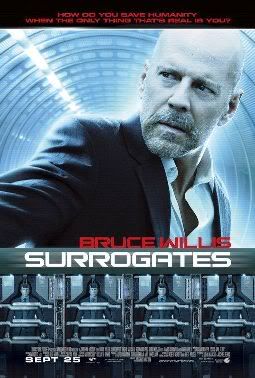
Review: Surrogates


There's a certain kind of excitement that washes over me whenever I read about a sci-fi movie which deals in a particularly heady subject.  For me, good, well thought out sci-fi is one of the best things in the world.  The worlds they present, the questions they pose, the conversations they spark; well-made science fiction can get my friends and I to argue and discuss and think about life's smallest issues as well as its grandest controversies.  At the same time, there's a certain kind of disappointment when a film with such promise squanders all of its potential.  Jonathan Mostow's Surrogates is just such a film.

The film presents a near-future in which 99 percent of the world's population (think on THAT one for a few minutes) operate robotic avatars from the safety of their own homes.  The robots look like flawless humans; physically superior versions of our fragile, ugly selves.  When the son of the surrogates' inventor is murdered through his surrogate, detective Tom Greer (Bruce Willis) is called on to find the killer.  Have I killed your interest yet?  Because this is precisely where I started tuning out.  Such a fantastic concept is given a backseat to a standard, run-of-the-mill murder mystery.

This wouldn't be such a big problem if the murder mystery weren't so completely labyrinthine.  In any other movie, it would be fairly straightforward.  With the presence of surrogates that anyone can swap out at any time, it becomes increasingly difficult to keep track which person is controlling which robot.  And then when you throw in red herrings and other typical murder mystery cliches, it all makes Surrogates more complicated than it needs to be, and less interesting than it ought to be.  Add to this the fact that the because movie isn't even 90 minutes long, there's little time for the movie to settle into any kind of rhythm, let alone explain itself clearly.

For what it's worth, the practical and CG effects for the actual surrogates is pretty top-notch.  In his robot form, Bruce Willis looks younger than he has in decades, which admittedly was the point, but it's offset by a hairpiece that's pretty laughable.  Other actors and their robo-selves come off better though (Rosamund Pike in particular), and on a purely basic level, the concept works.

Surrogates probably would've played better during the summer months where audiences might have been more willing to shut their brains off and enjoy the ride.    As it stands, the movie washes over you and seems to dare you to try and analyze it.  Instead, it squanders its massive potential in favor of exploring territory that was already effectively mined in I, Robot.  It's not really a bad film, but it could have been so much more.  In some ways, I think that makes Surrogates even worse.

2 ( sadsad ) stars out of five.

Wednesday, September 9, 2009

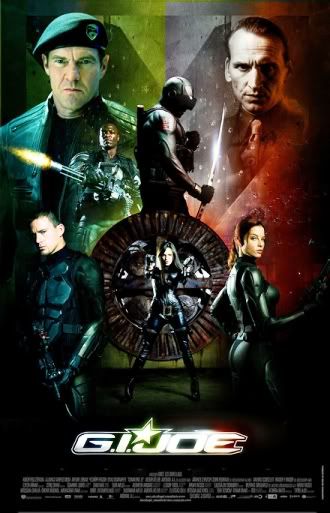
Review: G.I. JOE - The Rise of Cobra


Simply for reference, I'm going to link you to my review of Transformers: Revenge of the Fallen, because these are essentially the same movie.

Almost every complaint that I leveled at Transformers 2 can reasonably be applied to G.I. JOE - The Rise of Cobra.  It's loud, it's flashy, it's grade-A stupidity, and there are too many plot threads going on at once.  However, these two films differ on two key elements: Stephen Sommers' G.I. JOE at least attempts to make something resembling sense, and it never forgets to include that most crucial of summer blockbuster elements.  Fun.

The Rise of Cobra is a simple enough story.  US soldiers Duke (Channing Tatum) and Ripcord (Marlon Wayans) are attached to a unit transporting a case of biomechanical warheads.  The unit is attacked by super-armed terrorists Anna (Sienna Miller) and Storm Shadow (Byung-hun Lee), who are then thwarted by G.I JOE, an international super squad.  Duke and Ripcord tag along back to the G.I. JOE base, where they're integrated into the team.  From there, it becomes a long episode of the cartoon, complete with the Cobra terrorists stealing the warheads, attacking Paris, and G.I. JOE striking back.

In between the obligatory plot points, we're shown a lot of cool gadgets, no end of villainous posturing (by Christopher Eccleston and Joseph Gordon-Levitt, of all people), and several good gags along the way.  It should be noted that G.I. JOE is by no means a good film.  There's no question that it's exactly the same kind of lowest-common-denominator filmmaking that made Transformers 2 such a ridiculously huge hit a month ago.  As the lead actor, Channing Tatum sucks all the energy out of any scene he's in which, as it turns out, is most of them.  To balance him out, though, is a mostly well-chosen cast of Joes and Cobras to keep the film moving.  In fact, the amazing thing about the movie is how Tatum is the only one underplaying his role, when all around him are actors hamming it up.  It's almost as though Stephen Sommers forgot to tell him he was starring in a live-action cartoon.

Walking in, I had a pretty solid idea of what I was in for.  I knew I was sort of in for a repeat of Transformers 2.  For the first five minutes or so, that's what I got.  There was even a certain point early on where I completely zoned out and started thinking about something else entirely.  Thankfully, once the action started, I was surprised at how easy most of it was to follow.  While still chaotic and generally silly, there was never any confusion about what was going on.  Then I got to know the characters, and I was pleased to see that the film isn't nearly as far removed from the 1980s cartoon as I was expecting. 

Of course, for every interesting turn, there are a couple that are completely unnecessary.  The car chase through Paris is fun, but drags on for far too long.  Just about every major character has a character-building flashback (Storm Shadow has at least three), which give us details that were alluded to more fluently in previous scenes.  These scenes seem engineered to keep the less astute viewers up to speed, but to the keen eye they just feel tedious.

I suppose that I enjoyed G.I. JOE at all stems from the fact that my expectation was very, very low.  Of course, my expectation for Transformers 2 was equally low, if not lower, and I ended up hating that film.  So where's the disconnect?  Perhaps it's the fact that this film isn't nearly as in-your-face obnoxious.  Perhaps it's because there are no mind-bogglingly stupid gaps in logic (not that it's air-tight or anything). 

For whatever reason, I actually had a good time with G.I. JOE - The Rise of Cobra.  Granted, this isn't the kind of film I'll be revisiting any time soon, but for what it is, it's exactly the kind of fun that this summer has been sorely missing.  If you don't expect too much out of the film, it's surprisingly fun.  I realize that's faint praise, but that's exactly the kind of film this is.  Light, fun, and not too awful.

I'm giving this one 3  stars ( unsureunsureunsure ) out of five.

Monday, August 24, 2009

Review: District 9


 There are two types of science fiction.  Soft sci-fi and hard sci-fi.  Soft sci-fi is the kind of science fiction that's more about the action and spectacle of seeing things go boom, or take a sci-fi concept to tell an otherwise contemporary story.  It may take place in a futuristic or science-fictional setting, but there's little real science in it.  Think Transformers or The Time Traveler's Wife.  By contrast, hard sci-fi deals more closely with scientific concepts in telling its story.  Gattaca, Blade Runner, 2001, all of these would be considered hard sci-fi.  Very rarely will you find a movie or book that can blend the hard and soft without diluting the whole thing.  District 9 is the rare film that manages to do just that. 

28 years ago, an alien spacecraft entered Earth's atmosphere and came to rest hovering over Johannesburg, South Africa.  Deciding to be the first ones to make contact, human military units cut their way into the ship and discovered a plethora of worker aliens on the brink of death.  The aliens are removed from the ship and placed into temporary housing in a new district of Johannesburg.  District 9.  Present day, MNU (think United Way meets FEMA) employee Wikus van de Merwe (Sharlto Copley) is tasked with evicting all the aliens and relocating them to new, supposedly more efficient housing (District 10).

Needless to say, things don't go smoothly for Wikus.  Almost immediatly, he's infected with a mysterious alien fluid, and his body is confiscated by MNU for testing.  What began as a sort of faux-documentary soon becomes something more streamlined, as we follow Wikus' struggle to escape MNU, survive as a fugitive, and unravel the secret of District 9.  I'm only giving you the basics, and saying any more would ruin one of a hundred surprises that District 9 has up its sleeve. 

District 9 had something of a checkered production.  Early on, director Neil Blomkamp and producer Peter Jackson were in the planning phases of a Halo movie.  When the studios refused to give them the budget they wanted, Jackson gave Blomkamp considerably less money ($30 million) and carte blanche to make whatever he wanted.  The result, District 9, is adapted from Blomkamp's original short film "Alive in Joburg".  You can see the Halo influences in the film.  A lot of the vehicles and weapons used in the film were clearly meant to be Spartan assault rifles and Warthogs.  Not that that's important to enjoying the film, but it's something interesting to notice.

Now, earlier I said that District 9 blends the hard sci-fi and the soft sci-fi remarkably well.  Yes, there are high-minded concepts like bioengineering, apartheid, war crimes, weapon smuggling, etc.  There are some really tough issues to deal with in District 9, but they're not overbearing.  If you don't feel like contemplating alien apartheid, there are plenty of well-executed action sequences to keep you occupied.  And not only are they well-executed, but the effects work is remarkably convincing for such a small budget.  The aliens (derisively referred to as 'prawns') occasionally look too plasticy, but they never stick out like sore, alien thumbs. 

But perhaps the single greatest thing about District 9 is its central character, Wikus.  Wikus' journey is not an easy one to watch, but Blomkamp knows exactly when to make us fear for him, when to cry for him and when to cheer for him.  And trust me, you WILL be cheering for Wikus before the end.  But perhaps even more surprising than the human story is the alien story.  Wikus meets up with an alien engineer named Christopher Johnson.  Christopher and his Earth-born son have a plan for getting the mothership back online, and they form a tentative partnership with Wikus.  While Wikus' story is predictably grim, Christopher's story goes to some fairly dark places of its own.

Overall, District 9 is a complete tour-de-force of sci-fi storytelling.  It's completely engaging, fascinating, terrifying, and even a little heartbreaking.  I'm not even sure what I can compare this movie to, and I think that's going to be my ultimate praise.  This is a wholly original work that any fan of science fiction owes it to themselves to see at least once.

5 ( lollollollollol ) stars out of five.  Seriously.

Monday, August 17, 2009

Review: Ponyo

Ponyo may not be the greatest Hayao Miyazaki film of all time, but this is very possibly the best film for kids the director has delivered. Many children’s films in America try to rope in parental appreciation as well by including more risquĂ© jokes that will go over their children’s heads (I’m looking at you and your ilk, Shrek). This film keeps the humor sweet and simple, but crafted well enough that children and adults will enjoy it alike. Just look at the scene where five-year-old Sosuke and his mother communicate with his dad, a ship captain, via morse code and lanterns across the water, culminating in a short spousal argument blinked back and forth. Who can’t find some amusement in that?

While Ponyo lacks the epic scope of his most recent efforts Spirited Away and Howl’s Moving Castle, Miyazaki successfully adds some of the weight of those films to his formula for charming, deceptively simple children’s movies such as Kiki’s Delivery Service and the seminal My Neighbor Totoro. Whereas those two films focused primarily on the familial and social interactions of their young protagonists, this film gives equal weight to the conflict of man versus nature, as well as giving more focus to the adult relationships in the film. Miyazaki’s films have long been known for their pro-environment themes, which are never subtle but are rarely heavy-handed, more of just matter-of-fact, and it’s nice to see him include it in this film by showing how pollution contributes to throwing nature out-of-balance (the moon is almost crashing into the Earth). In fact, this balance wouldn’t be anywhere near as thrown off as it gets in the film if it weren’t for the magical goldfish Ponyo getting tossed into a glass jar by a fishing net, which then washes ashore, allowing Sosuke to find her and subsequently introduce her to the world of humans. The environmental message is simple enough for anyone to understand (pollution is bad and can destroy the world by throwing nature out of whack), but it never proselytizes, which would be to the loss of the charming story.

Another pleasant thematic change in this film as compared to his previous films for kids is the inclusion of the father who can’t bear to let his daughter ago. Ponyo’s father is at first adamantly against her becoming part of the human world, but upon seeing the joy it has brought her and at the behest of her mother he comes to understand that it’s not so bad to let his daughter go live her life the way which makes her happiest. Of course, that message might not be as obvious to the younger kids in the audience, but it’s a nice showcase of the difficulties of maturation that can at least bolster the notion that a child growing up is inevitable and okay on both sides of the generational gap.

Visually you can’t really ask for more out of an animated film than what Miyazaki brings to the plate in Ponyo. Whereas the foreground is more or less in his traditional style, the backgrounds have been rendered to look as though they were fashioned with crayon, colored pencil, and pastel. And considering this film was done in two dimensions by hand, they very well could have been crafted with these media. Even with the distinct smoothness of the foreground up against the softer impressionism in back, never do the two seem at odds with each other, but somehow seem to belong as parts of the same whole. By far this film is one of the best arguments to come out in the past few years to keep 2D animation alive. Disney may be going back to 2Danimation with The Princess and the Frog, but there really seems like there’s no way they could bring the level of brilliance and artistry that Miyazaki and his Studio Ghibli present here, so I’m glad to have seen such a great argument here for other artists not to abandon it.

While the visuals definitely take the cake as the best part ofthis film all around, the soundtrack isn’t too shabby either. Granted, since I saw the American release I didn’t get to hear the original Japanese tracks, but Miyazaki has a sweet deal cut with Disney so the American dub for his films is never lacking. For instance, this film has Liam Neeson asPonyo’s father, as well as Tina Fey and Matt Damon as Sosuke’s parents, to name a few. And yeah, Disney did rope in MileyCyrus’s little sister Noah to voice Ponyo, and the youngest Jonas sibling, Frankie, to voice Sosuke, but they’re kids voicing kids and their director got them to do the job just fine. Plus, with John Lasseter as an executive producer and Skywalker Sound working on the American release, it’s no wonder the American soundtrack is just fine. As for the music, the score is highly European in style and didn’t seem evocative of anything Japanese. In fact, some portions reminded me of Wagner’s works, which doesn’t surprise me at all since after a little internet sleuthing I turned up that the film was in part inspired by Wagner’s Die WalkĂ¼re (for example, Ponyo was named BrĂ¼nnhilde until Sosuke renamed her).

I would definitely recommend this film to people of all ages and walks of life, unless of course you absolutely can’t stand animation or movies without sex, drugs, and/or violence. But for everyone else, this is one of the sweetest, most heartfelt, and dazzling films to hit cinemas in a while, and it would be a shame to pass it up. And if you’re a Liam Neeson fan, you can always just pretend this is a sequel to Taken since his daughter goes missing in this one as well.

Sunday, August 9, 2009

Into the Vault: Dune

Although David Lynch's Dune (1984) was maligned in many a review, I actually quite enjoy it, albeit in its own way and for what does work in it. A lot of people deride this film for its flaws, and while I can definitely agree with at least some of them (the pacing is definitely screwed up), I try to appreciate what Lynch was able to make work under the terrible production requirements of the De Laurentiis clan. In other words, I find the film by the director to be quite enjoyable, but the film by the producers is quite flawed.

One of the first things a person might notice working for this film before even watching it is just how phenomenal the casting choices were, and they hold up past the credits. The young Kyle MacLachlan gives a subtlety to his transformation from "simple" Paul Atreides to the leader Muad'dib so his progress never seems jarring, even with the fast-paced editing Lynch was forced into so he could meet the requirement of delivering a two-and-a- half hour max film. We first meet Paul bright-faced and eager to learn about the universe he is about to travel into, but as he undergoes more and more hardships he smiles and beams less, adopting a stern glare that is yet not brutal, and a hard line to his mouth. One delectable performance of note is Sting as Feyd-Rautha, who barely talks but never needs to very much, his mad eyes taking in everything around him as if it is only a matter of time before he consumes it all. The only real complaint I have about the characters and acting in the film is the fact that not everyone is given as much screen time as they should have, such as Patrick Stewart as Gurney Halleck and Linda Hunt as Shadout Mapes, but this is most likely due to the fact that these characters were meant to be given more screen time but were forced into underdevelopment due to time constraints. And Lynch fans will be delighted to see many of his regulars pop up, such as Jack Nance as a Harkonnen captain, Dean Stockwell as Dr. Yueh, and Everett McGill as Stilgar.

As I've mentioned before, perhaps the greatest flaw in the film is the editing, which is constantly on the move, the plot rolling by at the pace of a trip down the open highway. We never get to sit back and really just take in the characters for who they are instead of for what they are doing. I highly doubt this is David Lynch's fault, though; if he needs to slow down and let shots and plot digest for a while in the viewer, even if it pushes the running time to three hours plus, he is a filmmaker who understands that this must be done. As such, I feel that the pacing problem in this film is simply because Lynch was forced to tell this story in under two and a half hours by the De Laurentiis'. The assembly cut he first delivered was four and a half hours long, and while this was longer than his final product was going to be, you can tell this movie is still much shorter than it was meant to be. Considering how the rest of Lynch's repertoire shows his capable skills for taking as much time as needed, from his first film, Eraserhead, to his latest, Inland Empire, I find it more than likely he is not to blame. Granted, David Lynch is one of my favorite filmmakers and I'm sure I am biased on this, but the fact that I really feel this film would have worked so much better if it weren't for the money behind the film, I find it quite easy to take the rushed editing in stride and enjoy the film. Plus, for the amount of story that Lynch had to cram into two and a half hours, the plot is amazingly coherent and still flows logically.

The other major point for which this film should be watched is the brilliant set designs, props, and costumes. The artistic direction of the film shows that Lynch is trained as a fine artist and knows how to make things simply look engaging. The homeworld and fleet of the Emperor are brilliantly barogue in design, covered in lavish gold and mirrors, evocative of Varseilles, but of course in space; this is science fiction, after all. The palace and accoutrement of the Atreides seem more indebted to 19th century European sensibilities, which reflects well the more pragmatic qualities of that house. Arrakis, the planet also known as Dune, didn't leave much to artistic design since it is simply desert, but the filming location in Chihuahua (yes, it's a place in Mexico, not just a dog) worked perfectly well in evoking the sense of what it should look like. My personal favorite for overall design, though, is the lodgings and clothing of the Harkonnen's, the brilliantly mad, technologically obssessed antagonists of the tale. With bright greens and steel blues everything about them seethes industry gone mad, where men have been lost to money and the progress of power through machines. Even the servants of the house are dehumanized, all outfitted with "heart plugs," designed for the film by Lynch, which act exactly how they sound in name: if one is pulled out, the heart is unplugged and leaks everywhere.

Of course, a review of Dune wouldn't be complete without mentioning the giant sandworms that live in the sands of Dune, and boy do they look good. I'm not exactly sure how they were created, but they definitely show that you don't need CGI to make a giant, awesome monster. These things have teeth like a lamprey but honestly look like they could crush you, interacting logically with their environments, never as if they'd been tossed in as a background layer.

Oh, and yes, other than the "Prophecy Theme" by Brian Eno, which is simply a great melody, the music is by Toto, but you wouldn't really notice other than the fact that there is electric guitar in the instrumentation. So don't let this fact distract you from the film or make you think that you're in for some post-'90's film featuring actual rock music throughout. The score is instrumental and more rooted in traditional film scores than many other '80's soundtracks, and therein lies the great distinction: this film has a score by Toto, not a soundtrack.
Another part of the film that is highly discussed is the manner in which the "weirding way" has been interpreted. In the original novel it involves intense, precise psychological control of one's musculature and nervous system, which would understandably be difficult to portray in film as opposed to literature, so it makes sense that it would be changed. And changed it is: the weirding way has become weirding modules, which are essentially guns that focus the energy found in certain sounds (which the wielder must make with his or her own voice) for different effects, but usually the end result is essentially a laser blast. By creating these weirding modules as a mode of combat based around sound, Lynch is able to literally turn Paul Atreides' adopted name Muad'dib into a "killing sound," as his name will trigger a lethal bolt from a weirding module. Although the weirding modules can definitely seem a little silly, watching these great warriors shouting odd noises to kill people, it's an engaging manner in which to present an idea or a sound representing an idea as directly lethal. Moreover, the sound of an army wielding these modules ends up evoking the battlecries many armies from around the world would use to intimidate their enemies; this time the battlecries just happen to be lethal themselves.

One part of the film on which I definitely am left ambivalent are the voiceovers. I understand why they're there in a film that has to cram so much plot and character development in such a short time; it really does help further the narrative in a logical way. But at the same time I really enjoy seeing plot and character development rather than essentially being told what plot and character development is occurring. Again, though, the time constraint put on the film definitely makes it impossible to properly develop these things through visuals and dialogue, and I did get used to the voiceovers as the film progressed.

In the end, Dune is definitely a flawed film, and by far David Lynch's weakest effort (even he doesn't like discussing this film, as he sees it as the one time in his career he truly sold out), but there is still so much to enjoy in the film that it shouldn't be overlooked based on its demerits. Instead, go in and appreciate the film for everything good that is there, because it honestly would be a better than good film if David Lynch had been allowed to do an actual three hour cut of it.

N.B. There is an extended cut of the film, but this was done without Lynch's consultation. Although there are a lot of things that do work nicely within the longer running time, the cut was made without Lynch's consultation, and as such he had his name removed from that version of the film. So if you want to see Lynch's Dune, the theatrical cut is the only way to go, as it is the only cut he has given approval to.

Monday, July 20, 2009

Review: Moon


A lot of different stories fall under the category of science fiction.  Space opera, time travel, cyberpunk, etc.  And though the 2000's have given us a number of great films in each of those categories, few if any have reached the heights of Star Wars, Back to the Future, or Blade Runner.  Enter Duncan Jones' film Moon.  I'm not saying it's as great as any of those films, but what it is is one of the purest science fiction films of the decade.  It's not as grandiose as the Star Wars prequels or as ambitious as, say, Danny Boyle's Sunshine, but in it's own way manages to fascinate and entertain in equal measures.  It gets so many of the minor details right that it really sucks you into the story.

Moon's story is a simple one.  Astronaut Sam Bell (Sam Rockwell) works on the Sarang mining base on the far side of the moon, where he's been working alone for the past three years.  His only companion is the base's robotic system, named GERTY (voiced by Kevin Spacey), and after three years Sam is starting to suffer the emotional stress of isolation.  During the final two weeks of his contracted stay, Sam discovers the base's dark secret (it's always a dark secret, isn't it?), and begins frantically searching for a way home.

I don't want to say anymore, because even though the film's twist comes 30 minutes in, the story is every bit as fascinating for where it doesn't go as where it does.  Certain parts of Moon are, indeed, predictable, but the film is deceptive in that it telegraphs just enough so the viewer thinks they have it figured out.  At other times, the film suggests certain forboding possibilities and then leaves it up to the viewer whether or not such things are the case.  The film offers several possibilities as to how Sam might end up dead, and then shows remarkable restraint in not overplaying its hand.

So yes, this is indeed a wonderful little piece of science fiction, but the real reason to seek out Moon is for Sam Rockwell's excellent performance.  He's more or less a one-man show here, and he's able to run the gamut of emotions, from emotional distress to violent rage to giddy aloofness, all in a matter of minutes.  Rockwell never oversells it or underplays it, but manages to hit that emotional sweet spot and make the viewer feel for this poor guy.

All the best science fiction films are about more than what's presented on the surface.  In just over 90 minutes, Moon manages to tackle space exploration, alternative energy, artificial intelligence, genetic engineering, space madness and, yes, dark corporate secrets.  That it meshes all of these into one brief, cohesive film is an impressive feat unto itself.  The finale is a bit on the underwhelming side, but there's still enough here to satisfy any sci-fi fan.  If you need a good, hard science fiction film to take the edge off junk like Transformers 2 or Star Trek, you owe it to yourself to check out Moon.

4.5 stars ( big grinbig grinbig grinbig grin1/2 ) out of 5.

Saturday, July 18, 2009

Review: Harry Potter and the Half-Blood Prince


Harry Potter is back again to grace us with the sixth installment of the series, and it's time to rollout a report card for the latest film. One of the biggest things I noted about Harry Potter and the Half-Blood Prince off the bat this time around is that you better be at least a little familiar with the series, as this is definitely part six of an ongoing franchise rather than a film you can pick up by itself. If you're not familiar with any of the staple characters (and this means all of them, not just Harry, Ron, and Hermione), you're probably in for a good amount of confusion as to who's who. Not a single character is really given an introduction besides the single major new addition, the well intentioned but dithering Professor Horace Slughorn. Many plot points are given with an understanding that you already have a good grasp of how the world of Harry Potter works, otherwise you might be scratching your head when Professor Dumbledore suddenly pulls out a bunch of vials containing memories. However, while this may be a detriment in ways, it is definitely necessary, as the plot in this film puts in place the beginning of the end of this saga. By the film's tragic close you can tell that every piece has been put into place so that a conclusive finale is just around the corner. So although some may be alienated by the insider tone of the film, too much explanation at this point in the series would have definitely detracted from what was necessary for this film to set up for the next.

As for how this measures up then in terms of the rest of the series, it's best compared to the previous installment, Harry Potter and the Order of the Phoenix, which was also directed by this film's helmsman, David Yates. Similar in visual style in many ways, they differ greatly in how they advance the plot. Where Phoenix was non-stop action, adventure, and intrigue from beginning to end, Yates and screenwriter Steve Kloves have definitely slowed things down this time to allow the characters to develop at a slower pace, all the while slowly building up the bleak atmosphere now dominating the wizarding world since war with Voldemort has more or less broken out.

One of the most distinct tenets of the character development in this film is the heavy presence of the fully teenaged romances the main trio is involved in. Hermione pines over Ron while he obliviously misses her advances and falls for a quidditch fangirl who wants to do nothing but snog him. Meanwhile, Harry pines for Ron's sister Ginny, which Hermione takes note of but Ron is oblivious of for the longest time, butting in at awkward times. While this all may seem a bit more soap opera than many were hoping for in what is otherwise a very dreary film, it serves not only as effective comic relief, but also emphasizes just how dark everything else is. These three are but teenagers caught up in a conflict that is far beyond the usual drama of their age group, which really brings to the forefront just how tragic it is that these otherwise normal teens have to deal with such terrible things.

And as for how dark the film is, I am simply astounded this film was rated PG by the MPAA, for I would severely hesitate about bringing a child under the age of ten to this film. Talk of murdering people as protective magic; a plot to assassinate a major character; willfully poisoning a mentor at his behest for the greater good; all of these alone would make a film heavy material for most kids, let alone all of them and more in a single film. There are also parts of the film that would definitely be very creepy to a lot of kids, such as when Harry and Dumbledore are attacked by gaunt golems in a very dark cavern. But of course, there are only a few times in the film that violence actually leads to bloodshed, so that means it must be acceptable for children, right?


The cinematography in the film is quite fantastic, going from dilapidated urban settings and the claustrophobic interior of Hogwart's to expansive views of the British countryside and moors. The darkness pressing on the manmade settings and the light bathing the shots of the countryside create a brilliant contrast, especially during the winter scenes when the land is covered in pure white snow. These jarring changes of scenery help keep the viewer subconsciously on edge throughout the film, adding to the level of tension permeating Hogwart's.

All the actors from the previous films are back in fine form, but a special mention must be given of Tom Felton, who brings a wrenching humanity to Dracy Malfoy that was never really seen in the other films. He may be a right bastard, but he still has a conscience lurking underneath his tormented interior somewhere, and Felton gives life to the turmoil beneath Draco's bravado, which he has never been able to show anyone in his life. Jim Broadbent plays Slughorn effectively, never overtaking a scene in anyway, which is exactly what is needed in a character that never wants too much attention because of the secret he can share with no one.

All in all, Harry Potter and the Half-Blood Prince is a welcome addition to the series. When the action actually picks up it will keep you gripped, and during the lulls you'll get to know how all the characters have matured in the wake of the previous film's events. If you've come to know the characters well, you'll find the humor and pathos of their lives touching, happy to see who they have grown into, but upset at what they must continue to suffer. The special effects are top-notch, and you should really pay attention to the details in the scene where Dumbledore puts a completely trashed room back in order and everything flies back together as if put in rewind, with characters standing in the midst of it all. After the successes of both Order of the Phoenix and Half-Blood Prince, which are only the second and third feature films directed by David Yates, I am more than curious to see where his career takes him as a director once he finishes with the rest of the Harry Potter series.

Sunday, July 12, 2009

Review: Bruno


Bruno is a difficult film to review.  On the one hand, it is extremely funny.  This is the hardest I've laughed at a film all year long.  If anything else, Bruno at least has that going for it.  But on the other hand, the novelty of Sacha Baron Cohen's shtick has clearly worn off.  Gone is the charming aloofness of Borat, a character who simply didn't know better, and in its place is a character whose shocking abrasiveness exists out of some bizarre desire to become famous at all costs.

The film opens with Austrian fashion reporter Bruno (Sacha Baron Cohen) committing career suicide by appearing at an Italian fashion show wearing a velcro suit.  Following the incident, he decides that the only course of action is to go to Hollywood and "become famous".  The bulk of the film is little more than a series of ridiculous sketches wherein Bruno tries out various methods of achieving fame.  Starring in a TV pilot, organizing a charity, attempting to end the conflict between Jews and Muslims, etc.

Sure, there's a loose framework of a story what with Bruno narrating the transitions between segments, but look past that and you'll see the film for what it really is: an 82 minute exercise in baiting homophobes, idiots, and assholes.  And yeah, that can be funny (and often is), but there's nothing to it.  There's no reason for Bruno's flamboyant rampage across the country. 

I think part of the problem is that, after Borat, we're all looking for the gimmick, the shtick, the gag.  Borat worked because most people had never heard of the character or the comedian underneath.  Now, Cohen's got to go pretty far out of his way to get a rise out of his audience.  It's still pretty easy to prank on unsuspecting people, but it feels like Cohen's trying too hard to entertain or shock his audience.  Here, the line is thankfully drawn at gay sex onscreen, but I have a feeling Cohen would go there if he thought it would get a reaction.

I guess my complaint boils down to the fact that Bruno is largely without subtext.  The movie is hilarious, and parts are certainly eye-opening (the finale, with Bruno playing the role of Straight Dave at a UFC event), but it all means nothing.  Borat worked because there was at least a through-line to the character's roadtrip across the US.  Bruno's quest to become famous simply reveals the film to be nothing more than the PR stunt that it wants us to think it's mocking.

If this kind of comedy is your thing, if you enjoyed Borat at all, you'll probably find Bruno pretty hilarious.  I definitely did.  Just don't try to read too much into it, because you almost certainly will find it lacking.

3 stars ( drydrydry ) out of five

Thursday, July 9, 2009

Review: Away We Go


Depending on what stage you're at in your relationship with your significant other, Away We Go would either make a perfect or a terrible date movie.  Having seen the film by myself, I personally couldn't say, but I'm willing to bet that you wouldn't want to see this on a first or second date.  Away We Go is the kind of film that likely will appeal more to newlyweds and parents than to teenagers on a first date.

Not to suggest that its demographic is set in stone or anything; that's based solely on the characters and their situation. The movie begins with Burt (John Krasinski) discovering that his longtime girlfriend Verona (Maya Rudolph) is pregnant.  Cut to months later, when the two visit Burt's parents (Catherine O'Hara, Jeff Daniels) to deliver the sonogram photos.  Here, Burt's parents announce that they're moving to Belgium right before the baby is due.  Burt and Verona take the news as an opportunity to pull up stakes and find a better home for themselves and the fast-approaching baby.

From there, the film hits its groove as a road trip movie, with our couple bouncing from Phoenix to Tuscon to Madison to Montreal to Miami in search of the perfect place to raise their daughter, only to find that all of their family and friends are tragically bad role models for both them and the baby.  Verona's former boss (Allison Janney) is a lush who sees no problem with disparaging her two pudgy kids in public.  Burt's childhood friend Ellen (Maggie Gyllenhaal) is a hippie/feminist/whatever with some... odd views on sexuality.  Their college roommates (Chris Messina, Melanie Lynskey) have adopted four kids while repeatedly failing to produce their own.

It seems like everywhere you look in this film, there's a horrible (or at the very least tragic) individual threatening to kill any hope for Burt, Verona, and even the viewer.  But to what end?  To show that everyone in the world is a terrible person?  That it doesn't matter where you live, problems exist everywhere? That's getting close to it, I think.

It still puzzles me why the film is little more than an episodic journey in bad parenting, but the counterpoint to that is the fact that John Krasinski and Maya Rudolph are pretty great in this film.  They're our proxies.  They think all these people are just as messed up as we do.  Krasinski plays Burt as a big kid who's whole-heartedly dedicated to bringing his own kid into the world the right way, and a lot of the film's charm rests solely on his shoulders.  In contrast, Maya Rudolph is calmer and more subdued than her work on Satuday Night Live suggested she could pull off.  If Krasinski is the comedic center of the film, Rudolph is the emotional center.

Overall, Away We Go isn't anything to rave about, but it's a far sight better than most of the big, dumb action movies released this summer.  If maybe not a truly memorable film, it is at least the perfect counterprogramming to the summer movie season.  I'd recommend it to anyone looking to escape from the exploding excess of films like Transformers, or those seeking a fresh take on the whole rom-com genre.

smilesmilesmilesmile 4 stars out of five

Thursday, June 25, 2009

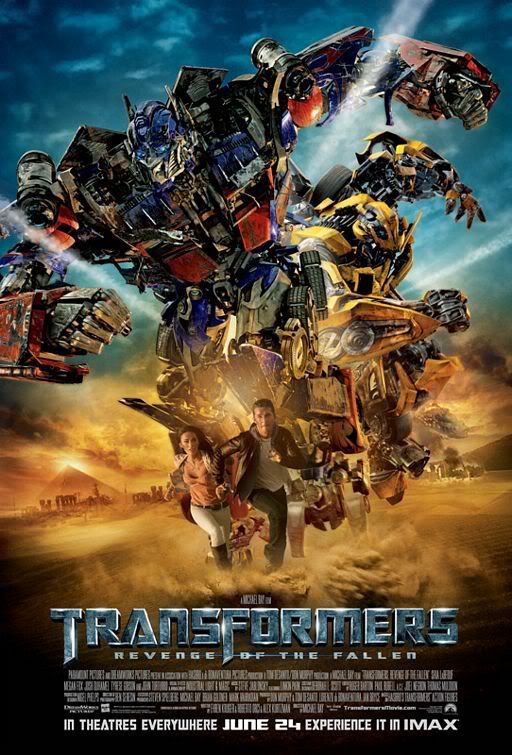
Review: Transformers: Revenge of the Fallen


 I am a male human.  I am twenty-two years old.  I am a sci-fi geek.  As a kid, I watched my share of Transformers cartoons.  I am, for all intents and purposes, the primary target audience for Michael Bay's Transformers movies.  And yet, I'm not sure whether I'm supposed to take Revenge of the Fallen seriously or if it's the biggest, most expensive and mind-numbing practical joke of the year.

One thing is certain: this film is definitely not a misfire.  Michael Bay and his three writers knew exactly what they were doing when they put this film together.  Revenge of the Fallen is a film that takes everything ridiculous, overblown and aggravating about the previous film and amplifies it tenfold.  For lack of a better comparison, it's Michael Bay's version of Crank 2.  Despite being a blatant ripoff of Independence Day, 2007's Transformers was at the very least coherent.  The sequel is far too scatterbrained and schizophrenic to even concentrate on one plot thread, let alone a dozen.

The film opens in Shanghai, with the Autobots working with a military team called NEST to hunt down rogue Decepticons.  Despite being a little hard to follow, this is a great concept for the film to start on, but the whole thing just goes downhill from there.  Meanwhile, after killing Megatron with the All Spark at the end of the first movie, Sam Witwicky (Still Shia LaBeouf, still annoying) is off to college, but not before discovering a sliver of the All Spark in his sweater, which imprints Cybertronian hieroglyphics onto his brain.  A Decepticon named The Fallen then arrives on Earth in search of the Matrix of Leadership, which he plans to use to destroy the sun (I guess).  The only one who knows it's location?  Yup.  Sam. 

That is literally the shortest plot description I can give you without simply saying "The Decepticons want something and the Autobots have to stop them from getting it."  Actually, that's all this movie is.  It's a fetch quest.  How Michael Bay managed to turn such a simple premise into 150 minutes is beyond me.  Of course, the plot doesn't really matter.  We're paying to see giant robots fighting, and by God that's exactly what Bay gives us.  What seems like the entire last hour of the film is dedicated to a battle in and around the Pyramids of Giza, and while it's definitely intricate and an amazing feat of special effects work, it makes practically zero narrative sense.

Entire plot threads are introduced only to be abandoned or twisted inside out thirty minutes later.  Characters die early in the film, only to be brought back at the zero hour.  Other characters seem motivated entirely by whims or hair-brained notions of their importance to the plot, others serve seemingly no purpose other than to maintain continuity, and still others show up for brief cameos, when I'm fairly certain they were killed off in the last film.

Thinking about Revenge of the Fallen for too long will almost certainly give you a headache, if the screening didn't do that for you already.  Failing that, the comic relief will drive you insane.  Not because it's hilarious, but rather because it's not and there's far, far too much of it.  In particular, two Autobots named Mudflap and Skids.  Of all the CG robots in this movie, they're the only two that actually resemble cartoon characters, and they're 100% walking, talking racial epithets of the worst kind.  Between those two and Sam's mother, this film features three of the absolute worst characters to show up in a film this year, possibly this decade.

Dogs humping dogs, robots humping people, robots speaking jive, robots walking with canes, people visiting robot heaven, John Turturro's ass.  Oh, and robot testicles.  Indeed, Transformers: Revenge of the Fallen truly has it all.  Every visual excess that you could possibly want in a summer blockbuster is right here, lovingly captured on film for all eternity.  If I have anything positive to say about the movie, it's that Michael Bay does, indeed, know how to make a film look good.  For every horribly stupid gag or plot point that Bay throws at us, we at least get to see what we paid for.  Giant robots kicking the crap out of each other.  But, ya know, sometimes that's just not enough.

The only reason I would possibly recommend seeing this would be to see how gloriously stupid the film truly is.

madmad  2 little angry faces out of 5.

Wednesday, June 3, 2009

Review: Up


The question of whether or not the new film from Pixar Animation Studios is any good is a moot one.  Of course it's good.  So far, Pixar's track record is ten for ten.  The debate rages on about Cars and A Bug's Life, but nobody will argue that they aren't at least well-crafted, if certainly not instant classics.  At this point, the question with Pete Docter's Up is instead how good is it?

Up shares a lot in common with Monsters, Inc., Docter's previous film, both in general quality and the way in which it tugs at the heartstrings.  Like Ratatouille and WALL-E before it, Up deals in a more sophisticated range of emotions that will almost certainly hit adults like a sledgehammer.  At the same time, the film balances its emotional weight with some truly weird humor and all sorts of sight gags that'll keep the kids laughing.

The film opens with perhaps one of the best montages ever put to film.  We follow an adventurous young boy named Carl as he meets his new best friend, an equally adventurous girl named Ellie.  From there, we watch the two plan for an adventure, only to give in to the slow march of time and the realities of life. After Ellie dies, urban construction threatens to take Carl's house, so rather than be put in a nursing home, Carl vows to take the trip he and Ellie always dreamed about: to Paradise Falls in South America.  From there, you've seen the trailers.  Carl and a stowaway boy scout named Russell fly off to South America in Carl's house, fitted with hundreds of balloons.

From there, not only does the plot get kinda strange, it also starts to fall apart a bit.  The journey that Carl and Russell take is never in question.  They go to South America, make an unexpected friend, meet an unexpected villian, and hijinks ensue.  Up's greatest strength lies in its ability to mine unexpected depth from characters in such wacky circumstances.  Without going into too many spoilers, Carl becomes a sort of father-figure to two characters, Russell and a talking dog named Dug.  That dichotomy of mentor/protege is what drives the second half of the story (not to mention the presence of talking dogs).

However, interesting though all that might be, the plot itself can't evenly support such weirdness.  I guess you could call the narrative a series of curveballs, because the plot does go exactly where you think it'll go, but the surprise is in how much time the film spends on any one part of the story.  Personally, I thought Carl's journey to Paradise Falls would be the driving force of the movie.  Instead, he and Russell make it there fairly quickly.  There was never any question that it would happen, but the way the film gets from point A to point B is a bit maddening.  I'm glad that my expectations were warped somewhat; I guess what I'm saying is that there has to have been a better way of pulling that off.

All narrative clunkiness aside, Up is a fantastic piece of animation.  If you don't leave the theater quoting Dug or the other dogs, you'll be marveling at the artistry behind Carl Fredrickson's facial stubble, or at the very least talking about how cute the short before the film, "Partly Cloudy", was.  It's wonderful to finally have a film this summer to rave about, however mildly.  Compared to some of the in-your-face explosionfests so far this summer, Up is a welcome hour and a half of fresh air.  (Heh.)

4 stars ( smilesmilesmilesmile ) out of five.